Have you ever stopped while typing because you weren’t sure whether the word is tomorrow or tommorow?
You’re definitely not alone.
This is one of the most common spelling mistakes in English. Even fluent speakers sometimes add an extra m by accident. Although spell check usually catches it, knowing the correct spelling yourself helps you write more confidently in emails, assignments, job applications, and everyday conversations.
In this guide, you’ll learn the correct spelling, why people make this mistake, simple memory tricks, plenty of examples, and practical tips to ensure you never spell tomorrow incorrectly again.
Featured Snippet
| Word | Correct? | Meaning |
|---|---|---|
| Tomorrow | ✅ Correct | The day after today or the future |
| Tommorow | ❌ Incorrect | A common misspelling of “tomorrow” |
Quick Answer:
The correct spelling is tomorrow. Tommorow is always incorrect in Standard English. Remember this simple rule:
Tomorrow = One M + Two Rs
This spelling is accepted in American English, British English, Australian English, Canadian English, and every major English dictionary.
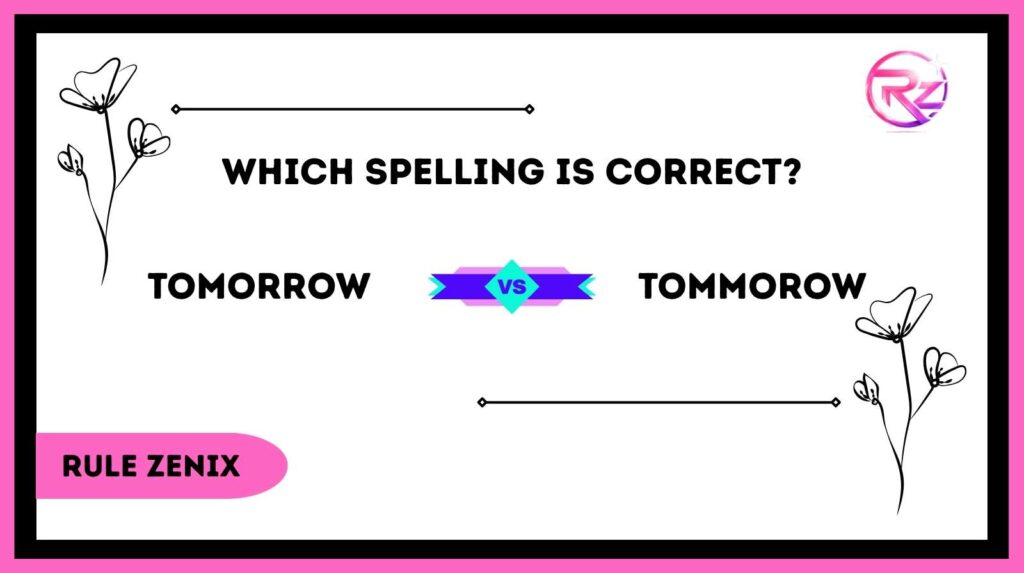
Tomorrow vs Tommorow: Which Spelling Is Correct?
The only correct spelling is tomorrow.
Many people mistakenly write tommorow because the pronunciation makes it sound as though there are two m letters. However, English spelling follows historical word formation rather than pronunciation alone.
Correct:
- I’ll finish the report tomorrow.
- We have an exam tomorrow morning.
- See you tomorrow.
Incorrect:
- I’ll finish the report tommorow.
- We leave tommorow.
- The meeting is tommorow.
Using the correct spelling makes your writing appear more professional and trustworthy.
Quick Answer
If you’re wondering whether tomorrow or tommorow is correct, here’s the simple answer:
✅ Tomorrow is the correct spelling.
❌ Tommorow is a misspelling and should never be used in formal or informal writing.
Whether you’re writing an email, text message, essay, or social media post, always choose tomorrow.
Why Is “Tommorow” Wrong?
The misspelling tommorow usually happens because English pronunciation can be misleading.
When we say the word aloud, it may sound like there are two m letters. However, English spelling doesn’t always match pronunciation exactly.
The correct letter pattern is:
- To
- Morrow
Together, they form:
Tomorrow
Many dictionaries list tommorow as a common misspelling, but not as a valid English word.
Quick Memory Trick
One of the easiest ways to remember the spelling is:
Tomorrow has ONE M and TWO Rs.
Think of it like this:
- ✅ One M
- ✅ Two Rs
Another easy trick:
Today → Tomorrow
Both words start with To.
Or remember this phrase:
Borrow tomorrow’s R, not another M.
These small memory tricks can help you avoid making the same mistake repeatedly.
What Does “Tomorrow” Mean?
Simple Definition
Tomorrow means the day after today.
It can also refer to the future, depending on the context.
Examples:
- We’re going shopping tomorrow.
- Tomorrow will be much warmer.
- Today’s decisions shape tomorrow.
Dictionary Meaning
According to the Merriam-Webster Dictionary, tomorrow means:
- The day following today.
- The future or time yet to come.
Pronunciation
Tomorrow
IPA (American English):
/təˈmɑːroʊ/
IPA (British English):
/təˈmɒrəʊ/
Simple pronunciation:
tuh-MOR-oh
Notice that pronunciation doesn’t include an extra m, even though many learners mistakenly hear one.
Common Contexts
The word tomorrow appears in many everyday situations.
Time
- I’ll call you tomorrow.
- Our flight leaves tomorrow morning.
School
- The homework is due tomorrow.
- We have a science quiz tomorrow.
Business
- Let’s schedule the meeting for tomorrow.
- I’ll send the report tomorrow afternoon.
Future Meaning
Sometimes tomorrow doesn’t mean the next day. Instead, it represents the future.
Example:
- Young people are the leaders of tomorrow.
- Technology is shaping the world of tomorrow.
Example Sentences
Here are some correct examples:
- I’ll finish the project tomorrow.
- Are you free tomorrow evening?
- Tomorrow is expected to be sunny.
- We leave for vacation tomorrow morning.
- Let’s discuss it tomorrow.
- Better opportunities may come tomorrow.
- Tomorrow brings a fresh start.
- She promised to reply tomorrow.
Incorrect:
- ❌ I’ll see you tommorow.
- ❌ The exam is tommorow.
- ❌ We’re leaving tommorow.
Always replace tommorow with tomorrow for correct English spelling.
Common Mistakes People Make
Although tomorrow is a simple everyday word, many people accidentally misspell it. Here are the most common errors:
| Incorrect Spelling | Correct Spelling |
|---|---|
| Tommorow | ✅ Tomorrow |
| Tommorrow | ✅ Tomorrow |
| Tomorow | ✅ Tomorrow |
| Tomarrow | ✅ Tomorrow |
All of these are considered spelling mistakes. Major dictionaries recognize tomorrow as the only correct spelling.
Why Do People Misspell “Tomorrow”?
There are several reasons why this mistake happens.
1. Pronunciation Can Be Misleading
When spoken quickly, some people think they hear two m letters instead of one.
For example:
- Correct pronunciation: tuh-MOR-oh
- Incorrect assumption: tom-mor-row
Because English spelling doesn’t always match pronunciation exactly, writers sometimes insert an extra m.
2. Typing Too Quickly
Fast typing often leads to accidental double letters.
Examples:
- tommorow
- tommorrow
This is especially common on smartphones and social media.
3. Confusing Letter Patterns
Many English words legitimately contain double m letters, such as:
- common
- summer
- committee
Because of this, learners sometimes assume tomorrow follows the same pattern but it doesn’t.
4. Lack of Proofreading
Even experienced writers occasionally type tommorow without noticing.
A quick proofreading pass or spell checker usually catches the error before publishing.
Easy Ways to Remember the Correct Spelling
If you often forget the spelling, these tricks can help.
Trick 1: One M, Two Rs
Remember:
Tomorrow = 1 M + 2 Rs
This is the easiest rule for most learners.
Trick 2: Break the Word
Split it into smaller parts:
To + Morrow
The second part, morrow, is an old English word related to the next day or morning, which explains why the modern spelling contains only one m.
Trick 3: Visual Practice
Write the word several times:
- Tomorrow
- Tomorrow
- Tomorrow
- Tomorrow
Repeated writing helps build muscle memory.
Trick 4: Use It in Sentences
The more often you use the correct spelling, the easier it becomes to remember.
Examples:
- I’ll visit my grandparents tomorrow.
- We have a football match tomorrow.
- Tomorrow is another opportunity to improve.
Tomorrow in Everyday Writing
The word appears in many types of writing.
Emails
I’ll send the updated document tomorrow.
School Assignments
The project is due tomorrow morning.
Workplace Communication
Let’s continue this discussion tomorrow.
Casual Conversations
Are you free tomorrow evening?
Using the correct spelling creates a better impression and avoids unnecessary corrections.
American vs British English
Unlike words such as color/colour or organize/organise, there is no spelling difference between American English and British English.
Both use:
✅ Tomorrow
Neither variety accepts tommorow as correct.
Quick Checklist
Before publishing anything, ask yourself:
- ✅ Did I write tomorrow?
- ✅ Did I avoid writing tommorow?
- ✅ Did I proofread my writing?
- ✅ Did my spell checker confirm the spelling?
- ✅ Does every sentence look natural?
If you answered “Yes” to all five, you’re using the correct spelling confidently.
Real-Life Example: How One Small Spelling Mistake Changed a First Impression
Imagine Sarah, a university student applying for a summer internship. She carefully prepared her resume and wrote a professional email to the hiring manager.
At the end of her message, she wrote:
“I look forward to hearing from you tommorow.”
Everything else in the email was excellent, but the spelling mistake stood out immediately. While the employer didn’t reject her because of one typo, it created the impression that the email hadn’t been proofread.
Before sending a follow-up message, Sarah reviewed her writing with a spell checker and noticed the mistake. She corrected tommorow to tomorrow and made proofreading a habit before sending important documents.
This simple experience taught her an important lesson: small spelling mistakes can affect how professional your writing appears. Whether you’re applying for a job, submitting schoolwork, writing business emails, or publishing blog content, correct spelling helps build credibility and confidence.
Fortunately, mistakes like tommorow are easy to avoid once you remember the rule:
Tomorrow = One M + Two Rs
A few extra seconds of proofreading can save you from embarrassing spelling errors and leave a stronger first impression.
Spelling Statistics (2025–2026)
Although tomorrow is a very common everyday word, it’s also one of the words people misspell most often.
Recent language resources and spelling studies show:
| Statistic | Insight |
|---|---|
| Dictionary Status | Only tomorrow is accepted as the correct spelling. |
| Common Misspellings | tommorow, tommorrow, tomorow, and tomarrow are among the most frequent errors. |
| 2026 Search Trends | “Tomorrow” ranked among America’s most commonly misspelled words in search data during 2026. |
| Grammar Resources | Leading grammar websites consistently recommend remembering the pattern “One M, Two Rs.” |
These findings show that you’re not alone if you’ve ever typed tommorow by mistake. The good news is that once you learn the correct pattern, it’s an easy error to eliminate.
Mini Quiz: Test Your Knowledge About Tomorrow vs Tommorow
Mini Quiz 1: Which Spelling Wins?
Question: Which spelling is correct?
Answer: ✅ Tomorrow
Mini Quiz 2: Find the Mistake
Question: Which word is misspelled?
Answer: ❌ Tommorow
Mini Quiz 3: Count the M
Question: How many M letters are in tomorrow?
Answer: ✅ One
Mini Quiz 4: Count the R
Question: How many R letters are in tomorrow?
Answer: ✅ Two
Mini Quiz 5: Fill in the Blank
Question: I’ll call you ______.
Answer: ✅ Tomorrow
Mini Quiz 6: True or False?
Question: “Tommorow” is a correct English word.
Answer: ❌ False
Mini Quiz 7: Quick Meaning
Question: What does tomorrow mean?
Answer: ✅ The day after today
Mini Quiz 8: Choose the Right Sentence
Question: Which sentence is correct?
Answer: ✅ We are leaving tomorrow.
Mini Quiz 9: Memory Trick
Question: What’s the easiest spelling rule?
Answer: ✅ One M and Two Rs
Mini Quiz 10: Everyday Writing
Question: Which word should you use in emails and school assignments?
Answer: ✅ Tomorrow
Mini Quiz 11: Around the World
Question: Is tomorrow spelled differently in British English?
Answer: ❌ No
Mini Quiz 12: Why the Confusion?
Question: Why do many people write tommorow?
Answer: ✅ Because the pronunciation can be misleading.
Mini Quiz 13: Finish the Sentence
Question: Tomorrow means the ______ after today.
Answer: ✅ Day
Mini Quiz 14: Spot the Wrong Word
Question: Which spelling should you avoid?
Answer: ❌ Tommorow
Mini Quiz 15: One-Word Challenge
Question: What’s the correct spelling?
Answer: ✅ Tomorrow
Mini Quiz 16: Writing Tip
Question: What should you always do before sending important writing?
Answer: ✅ Proofread it
Mini Quiz 17: Think Ahead
Question: Can tomorrow also mean the future?
Answer: ✅ Yes
Mini Quiz 18: Final Spelling Test
Question: Complete the rule:
Tomorrow = One ___ and Two ___.
Answer: ✅ One M and Two Rs
Frequently Asked Questions
Is it tomorrow or tommorow?
The correct spelling is tomorrow. Tommorow is a spelling mistake and should not be used in formal or informal writing.
Why do people spell tomorrow as tommorow?
Most people accidentally add an extra m because the word’s pronunciation can be misleading or because they type quickly.
How many M’s are in tomorrow?
Only one M.
Correct:
Tomorrow
Incorrect:
Tommorow
How many R’s are in tomorrow?
There are two Rs.
Remember:
Tomorrow = 1 M + 2 Rs
Is “tommorow” in the dictionary?
No. Standard English dictionaries list it only as a common misspelling, not as a correct word.
Is tomorrow the same in American and British English?
Yes. Both American English and British English use exactly the same spelling:
Tomorrow
What’s the easiest way to remember the spelling?
The best memory trick is:
One M, Two Rs
You can also remember that the second part is morrow, which helps explain the spelling.
Can spell check automatically fix “tommorow”?
Most modern writing tools and browsers recognize tommorow as a misspelling and suggest tomorrow, but you shouldn’t rely on autocorrect alone. Learning the correct spelling improves your writing confidence.
Conclusion
When comparing Tomorrow vs Tommorow, the answer is simple: tomorrow is the only correct spelling.
Although tommorow is one of the most common English spelling mistakes, it’s also one of the easiest to fix. Remember the simple rule:
- One M
- Two Rs
- Tomorrow ✅
Whether you’re writing emails, essays, blog posts, professional documents, or text messages, using the correct spelling helps your writing look polished and credible.
The next time you hesitate between Tomorrow vs Tommorow, you’ll know exactly which one to choose.
Continue learning with simple grammar lessons on Rule Zenix
Trusted References

I’m Muhammad Bilal, the founder of Rule Zenix and a passionate English grammar content creator with one year of experience. I create simple, accurate, and practical guides on grammar, punctuation, vocabulary, and writing to help students, professionals, and English learners improve their communication skills with confidence.