Have you ever typed “dought” instead of “doubt” and wondered whether both words are correct? You’re not alone. Thousands of English learners make this spelling mistake because “doubt” has a silent B, making it easy to misspell.
Understanding the difference is important whether you’re writing an email, school assignment, blog post, or social media caption. Using the wrong spelling can make your writing look less professional and may confuse your readers.
In this guide, you’ll learn the correct spelling, meaning, pronunciation, grammar rules, examples, memory tricks, and common mistakes so you’ll never confuse dought vs doubt again.
Featured Snippet
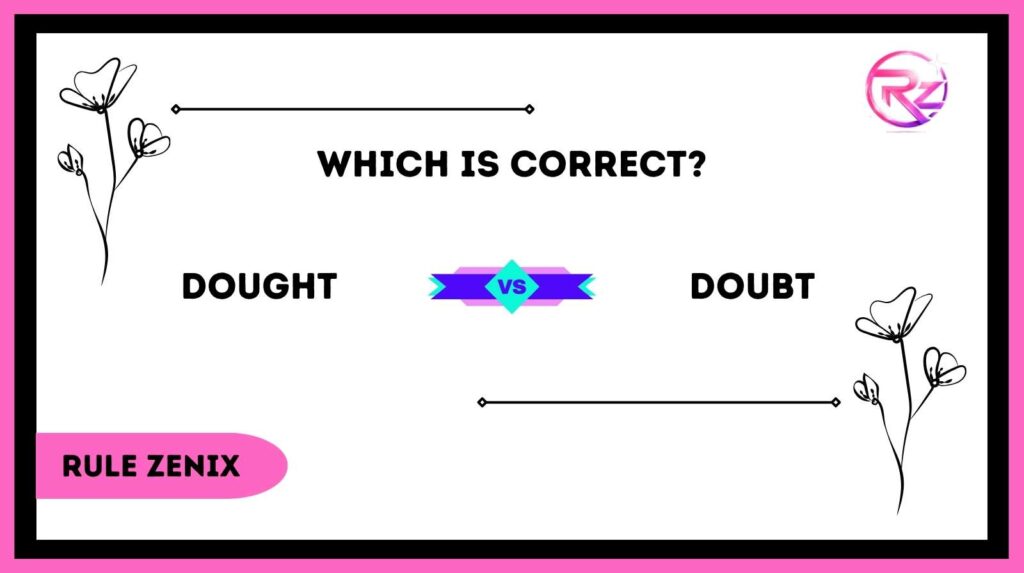
The correct spelling is doubt.
Dought is not a standard English word and is considered a spelling mistake in modern English. Whenever you want to express uncertainty or a lack of confidence, always use doubt.
Correct: I doubt he will arrive on time.
Incorrect: I dought he will arrive on time.
Dought vs Doubt: Which Is Correct?
Many people accidentally write dought because English pronunciation doesn’t always match spelling. Since the B in doubt is silent, some writers guess the spelling incorrectly.
Remember this simple rule:
- Doubt = Correct English word
- Dought = Incorrect spelling
This spelling rule applies in every type of English writing, including academic, business, and everyday communication.
Quick Answer
If you’re unsure which one to use, always choose doubt.
Why Is “Dought” Wrong?
Modern English dictionaries do not recognize dought as the correct spelling for uncertainty.
The confusion usually happens because English contains many silent letters, such as:
- debt
- subtle
- thumb
- doubt
In each of these words, one letter is silent but must still be written correctly.
Quick Memory Trick
Remember this sentence:
“Never Doubt the Silent B.”
Whenever you hear the word, picture the hidden B helping you remember the correct spelling.
Also Read: Become vs Became: Difference, Meaning & Examples
What Does “Doubt” Mean?
The word doubt refers to uncertainty, hesitation, or a lack of confidence about something being true or likely.
It can be used as both a noun and a verb.
Dictionary Meaning
Doubt (noun): A feeling of uncertainty.
Doubt (verb): To question whether something is true.
Pronunciation
Doubt: /daʊt/
Notice that the B is completely silent.
Common Contexts
People commonly use doubt when talking about:
- uncertainty
- trust
- confidence
- decision making
- predictions
- beliefs
Example Sentences
I doubt that it will rain today.
There is no doubt she worked hard.
Many people doubt the rumor.
He never doubted his team’s ability.
Without a doubt, she deserves the award.
Why Do People Misspell Doubt?
English spelling follows historical patterns rather than pronunciation alone.
Because the B is silent, learners often spell the word exactly as it sounds.
Other factors include:
Silent Letters
English contains many silent letters that confuse writers.
Examples include:
- doubt
- debt
- lamb
- thumb
- subtle
Fast Typing
Typing quickly often leads to accidental spelling mistakes.
Autocorrect Dependence
Many writers rely on spell checkers instead of learning correct spelling rules.
Limited Vocabulary Practice
Reading less frequently reduces familiarity with correct spellings.
Dought vs Doubt Comparison Table
| Feature | Doubt | Dought |
|---|---|---|
| Correct English Word | ✅ Yes | ❌ No |
| Found in Dictionaries | ✅ Yes | ❌ No |
| Used in Formal Writing | ✅ Yes | ❌ Never |
| Means Uncertainty | ✅ Yes | ❌ No |
| Safe for Exams | ✅ Yes | ❌ No |
Whenever you’re writing, choose doubt.
Also Read: Emaculate vs Immaculate: Which One Is Correct? (2026 Guide)
Real-Life Example: Why Correct Spelling Matters
Imagine a university student preparing an important scholarship application. After spending hours writing a personal statement, they include the sentence, “I dought I would have reached this point without my teachers.” Although the message is heartfelt, the spelling mistake immediately catches the reviewer’s attention. Even a small error like this can reduce the professionalism of an otherwise excellent application.
The student later reviews the document using a dictionary and realizes that dought is not an accepted English word. They replace it with doubt, resulting in the correct sentence: “I doubt I would have reached this point without my teachers.” The corrected version reads naturally and demonstrates stronger writing skills.
This example highlights an important lesson. Correct spelling builds trust with readers, whether you’re writing academic papers, business emails, resumes, or online content. Paying attention to commonly confused words like doubt helps your writing appear polished, accurate, and credible. Developing the habit of proofreading can prevent simple mistakes that leave a lasting impression.
Spelling Data and Language Trends (2025–2026)
Recent language learning trends show that silent-letter words remain among the most frequently searched English spelling topics. Words such as doubt, debt, subtle, and thumb consistently appear in spelling-related searches because learners often write them according to their pronunciation.
Educational platforms have also reported that silent-letter words continue to challenge English learners at all proficiency levels. This highlights the importance of learning spelling patterns rather than relying only on pronunciation. Mastering these commonly confused words improves writing accuracy, exam performance, and professional communication.
How to Remember the Correct Spelling
Learning spelling doesn’t have to be difficult. Try these simple techniques.
Remember the Silent B
Think of the phrase:
“The silent B makes doubt complete.”
Read More English Content
Reading books, articles, and newspapers naturally reinforces correct spelling.
Practice Writing
Write five sentences using doubt every day.
Proofread Before Publishing
Always review your writing before sending emails or publishing documents.
Also Read: Training or Trainning: Which Is Correct? (2026 Guide)
Common Mistakes to Avoid
Avoid these common errors:
❌ I dought he is correct.
✅ I doubt he is correct.
❌ There is no dought about it.
✅ There is no doubt about it.
❌ We dought their decision.
✅ We doubt their decision.
Even small spelling corrections can greatly improve your writing quality.
Doubt as a Noun vs Doubt as a Verb
One reason doubt is such a useful English word is that it can function as both a noun and a verb. Knowing the difference will help you use it correctly in every situation.
Doubt as a Noun
As a noun, doubt means a feeling of uncertainty or lack of confidence.
Examples:
- There is no doubt that she worked hard.
- His answer raised serious doubts.
- Without a doubt, this is the best option.
- I have some doubts about the plan.
- Their success removed every doubt.
Doubt as a Verb
As a verb, doubt means to question or not believe something completely.
Examples:
- I doubt he knows the answer.
- She doubts the story is true.
- They doubted his experience at first.
- Never doubt yourself.
- We don’t doubt your honesty.
Also Read: Transferred or Transfered: Which Is Correct? (2026 Guide)
Common Expressions with “Doubt”
The word doubt appears in many everyday English expressions. Learning these phrases will make your English sound more natural.
Without a Doubt
Meaning: Certainly; definitely.
Examples:
- She is without a doubt the best player on the team.
- That was without a doubt the funniest movie I’ve seen this year.
No Doubt
Meaning: Certainly or probably.
Examples:
- He will no doubt succeed.
- There is no doubt that practice improves your skills.
Beyond Doubt
Meaning: Completely certain.
Examples:
- His honesty is beyond doubt.
- The results proved their success beyond doubt.
In Doubt
Meaning: Unsure or uncertain.
Examples:
- If you’re in doubt, ask your teacher.
- She remained in doubt about the final decision.
Cast Doubt On
Meaning: To make something seem less believable.
Examples:
- New evidence cast doubt on the report.
- His explanation cast doubt on the original story.
Words Commonly Confused with Doubt
Many English learners confuse doubt with similar-looking or similar-sounding words.
| Word | Meaning | Correct Usage |
|---|---|---|
| Doubt | Uncertainty | I doubt his claim. |
| Debt | Money owed | He paid his debt. |
| Debut | First public appearance | Her debut was successful. |
| Doubtful | Uncertain | I’m doubtful about the result. |
| Undoubtedly | Certainly | She undoubtedly deserves the award. |
Although some of these words share similar spellings, their meanings are completely different.
Examples of “Doubt” in Everyday Situations
Understanding real-life usage makes spelling much easier to remember.
At School
“I doubt the exam will be easy.”
At Work
“Our manager doesn’t doubt our abilities.”
During Travel
“I doubt we’ll reach the airport before noon.”
At Home
“There is no doubt this recipe tastes better.”
While Shopping
“I doubt this store is open today.”
Also Read: Pursue or Persue? Learn The Correct Spelling Of Pursue
Mistakes Students Frequently Make
Even advanced English learners sometimes misuse doubt.
Here are the most common mistakes.
Mistake 1: Writing “Dought”
❌ I dought he is right.
✅ I doubt he is right.
Mistake 2: Forgetting the Silent B
Many learners spell words exactly as they hear them.
Correct spelling requires remembering that the B is written but not pronounced.
Mistake 3: Using the Wrong Verb Form
❌ I am doubt this answer.
✅ I doubt this answer.
OR
✅ I have doubts about this answer.
Mistake 4: Mixing Up Noun and Verb Forms
❌ My doubt him.
✅ I doubt him.
OR
✅ I have doubts about him.
Quick Checklist Before You Write
Before using the word in your writing, ask yourself:
- ✅ Did I spell doubt with a silent B?
- ✅ Am I using the correct meaning?
- ✅ Does the sentence sound natural?
- ✅ Have I proofread my work?
- ✅ Did spell check confirm the spelling?
Following this checklist can help eliminate one of the most common English spelling mistakes.
Also Read: Tomorrow vs Tommorow: Which Spelling Is Correct? (2026)
Mini Quiz: Dought vs Doubt
1. Mini Quiz: Which spelling is correct?
Answer: ✅ Doubt
2. Mini Quiz: Is “dought” a correct English word?
Answer: ❌ No
3. Mini Quiz: Which word means uncertainty?
Answer: ✅ Doubt
4. Mini Quiz: Which letter is silent in “doubt”?
Answer: ✅ B
5. Mini Quiz: Complete the sentence: “I _____ he is telling the truth.”
Answer: ✅ Doubt
6. Mini Quiz: Which sentence is correct?
A. I dought the answer.
B. I doubt the answer.
Answer: ✅ B. I doubt the answer.
7. Mini Quiz: Is “doubt” a noun, a verb, or both?
Answer: ✅ Both
8. Mini Quiz: Which phrase is correct?
A. Without a dought
B. Without a doubt
Answer: ✅ Without a doubt
9. Mini Quiz: What does “doubt” mean?
A. Happiness
B. Uncertainty
C. Success
Answer: ✅ Uncertainty
10. Mini Quiz: Which spelling should you use in exams?
Answer: ✅ Doubt
11. Mini Quiz: True or False?
The B in doubt is pronounced.
Answer: ❌ False
12. Mini Quiz: Fill in the blank.
“There is no _____ about her talent.”
Answer: ✅ Doubt
13. Mini Quiz: Which word is found in English dictionaries?
A. Dought
B. Doubt
Answer: ✅ Doubt
14. Mini Quiz: Which sentence is incorrect?
A. We doubt the news.
B. We dought the news.
Answer: ✅ B. We dought the news.
15. Mini Quiz: Which memory trick helps you remember the spelling?
A. Silent D
B. Silent B
Answer: ✅ Silent B
16. Mini Quiz: Which is the plural form?
A. Doubts
B. Doughts
Answer: ✅ Doubts
17. Mini Quiz: Complete the phrase.
“_____ a doubt.”
Answer: ✅ Without
18. Mini Quiz: Final Challenge!
Which sentence is completely correct?
A. I dought she will come today.
B. I doubt she will come today.
Answer: ✅ B. I doubt she will come today.
Frequently Asked Questions
Is “dought” a real English word?
No. Dought is not accepted as the correct spelling for expressing uncertainty in modern English. Always use doubt.
Why is the B silent in “doubt”?
The silent B comes from the word’s historical development and Latin origin. Although it isn’t pronounced, it remains part of the correct spelling.
Can I use “dought” in formal writing?
No. Using dought in essays, reports, emails, or professional documents is considered a spelling mistake.
Is “doubt” a noun or a verb?
It can be both.
- Noun: I have no doubt.
- Verb: I doubt his explanation.
How do I remember the correct spelling?
Remember this phrase:
“Never doubt the silent B.”
This simple memory trick helps many English learners avoid the mistake.
What is the opposite of doubt?
Common opposites include:
- certainty
- confidence
- belief
- assurance
Is “without a doubt” grammatically correct?
Yes. It is a very common English expression that means definitely or certainly.
Example:
“She is without a doubt the best candidate.”
Does “doubt” have a plural form?
Yes.
The plural form is doubts.
Example:
“I still have doubts about the proposal.”
Final Thoughts
Understanding the difference between dought and doubt is easier than it first appears. The key takeaway is simple: doubt is the only correct spelling in modern English, while dought is a common misspelling that should be avoided in all types of writing.
Because the B in doubt is silent, many learners naturally spell the word the way it sounds. However, remembering the silent B, reading regularly, and proofreading your work can help you avoid this mistake every time.
Whether you’re writing an academic essay, a business email, a social media post, or everyday messages, using the correct spelling demonstrates strong language skills and improves your credibility as a writer.
The next time you hesitate between dought and doubt, remember this simple rule:
If you mean uncertainty or lack of confidence, always write “doubt.” Never use “dought.”
With consistent practice, you’ll build better spelling habits and write English with greater confidence.
Continue learning with simple grammar lessons on Rule Zenix
Trusted References
- Merriam-Webster Dictionary. Doubt. Merriam-Webster.
- Cambridge Dictionary. Doubt. Cambridge University Press.

I’m Muhammad Bilal, the founder of Rule Zenix and a passionate English grammar content creator with one year of experience. I create simple, accurate, and practical guides on grammar, punctuation, vocabulary, and writing to help students, professionals, and English learners improve their communication skills with confidence.