Have you ever typed trainning and wondered whether your spell checker was right to flag it? You’re not alone. Thousands of English learners, students, and professionals make this spelling mistake every month because the word seems like it should contain a double n.
The truth is simple: training is the only correct spelling. Trainning is a misspelling and should never be used in formal or informal English writing.
In this guide, you’ll learn the difference between training and trainning, why the mistake happens, the spelling rule behind it, practical examples, and an easy memory trick so you never get it wrong again.
Featured Snippet
Training is the correct spelling. Trainning is incorrect and is not recognized in standard English dictionaries. The word training comes from train + ing, and the final n is not doubled because train ends with a long vowel sound followed by a single consonant.
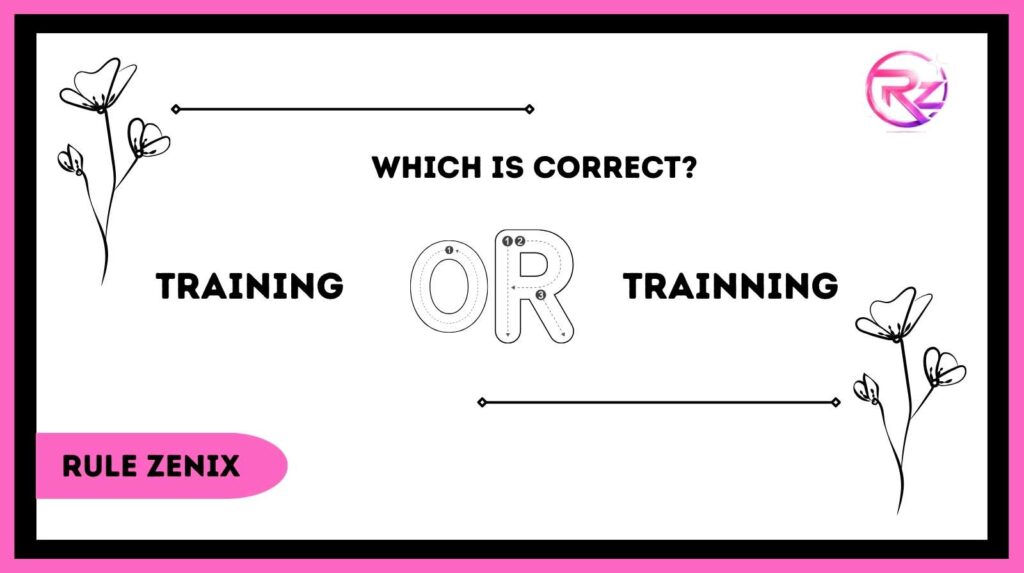
Training or Trainning: Which Is Correct?
If you’re looking for the quick answer, here it is.
| Word | Correct? | Meaning |
|---|---|---|
| Training | ✅ Yes | The process of learning or teaching skills |
| Trainning | ❌ No | Incorrect spelling |
Whether you’re writing a resume, preparing an assignment, creating business documents, or publishing online content, always use training.
Quick Answer
The correct spelling is training.
❌ Trainning
✅ Training
The word comes from the verb train, and when adding -ing, you simply write:
train + ing = training
No extra n is added.
Why Is “Trainning” Wrong?
Many people believe another n should be added before -ing, but English spelling rules don’t support that.
The word train already ends with:
- two vowels (ai)
- followed by one consonant (n)
Since the vowel isn’t short, the final consonant is not doubled.
That’s why:
- train → training ✅
- train → trainning ❌
Quick Memory Trick
Remember this sentence:
A train only needs one track and “training” only needs one N.
Whenever you think about spelling the word, picture a train running on one track. That image makes it much easier to remember that training contains only one n before -ing.
What Does “Training” Mean?
Training refers to the process of learning, teaching, or improving a particular skill, ability, or area of knowledge. It helps people become more capable through practice, instruction, or experience.
The word is commonly used in education, sports, workplaces, healthcare, military settings, and many other fields.
Simple Definition
Training means learning how to do something better through practice or instruction.
Dictionary Meaning
Training is:
The process of developing knowledge, skills, or abilities through teaching, practice, or experience.
It can describe both formal education and practical skill development.
Pronunciation
Training
Pronunciation: /ˈtreɪ.nɪŋ/
Sounds like:
TRAY-ning
Common Contexts
You may see training used in many everyday situations, including:
- Employee training
- Job training
- Staff training
- Safety training
- Software training
- Military training
- Athletic training
- Teacher training
- Online training
- Customer service training
Each refers to learning skills or improving performance in a specific area.
Example Sentences
Here are some natural examples of training used correctly.
- The company provides excellent training for new employees.
- She completed first aid training last month.
- Daily training improved the athlete’s performance.
- We attended online training before using the new software.
- Proper training helps reduce workplace accidents.
- The dog responded well after several weeks of training.
- Teachers receive ongoing training throughout the school year.
- Good customer service starts with effective training.
Notice that every correct example uses training, never trainning.
Why Do People Misspell “Training” as “Trainning”?
At first glance, trainning may seem logical because many English words double their final consonant before adding -ing. However, that rule only applies in certain situations.
Understanding why the mistake happens makes it much easier to avoid.
The Double Consonant Confusion
Compare these examples:
- run → running ✅
- swim → swimming ✅
- sit → sitting ✅
In these words, the final consonant doubles because they end with a short vowel followed by a single consonant.
Many learners mistakenly think train follows the same rule.
It doesn’t.
The Spelling Rule
The word train contains the vowel combination ai, which creates a long vowel sound.
Because of this, the final n is not doubled when adding -ing.
Correct formation:
train + ing = training
Incorrect formation:
train + ning = trainning
This simple spelling rule explains why training is always correct.
Other Similar Examples
These words follow the same pattern:
| Base Word | Correct -ing Form |
|---|---|
| rain | raining |
| sail | sailing |
| clean | cleaning |
| paint | painting |
| dream | dreaming |
| train | training |
Notice that none of these words double the final consonant.
Their vowel sounds are long, so adding -ing is straightforward.
Common Mistakes to Avoid
Even advanced English learners occasionally confuse training with trainning. Here are the mistakes you should watch out for.
Mistake 1: Doubling the Final N
❌ We completed safety trainning.
✅ We completed safety training.
Mistake 2: Using Spellings Found on Social Media
Sometimes you’ll notice trainning in comments, captions, or online posts. Just because many people write it doesn’t make it correct.
Always rely on standard English spelling instead of copying common online mistakes.
Mistake 3: Assuming Every Verb Doubles the Last Letter
Not every verb follows the same pattern.
Compare:
- run → running ✅
- swim → swimming ✅
- train → training ✅
- paint → painting ✅
Learning the spelling rule is much more reliable than guessing based on appearance.
Training vs Trainning: Side-by-Side Comparison
If you’re ever unsure which spelling to use, this table gives you the answer at a glance.
| Feature | Training | Trainning |
|---|---|---|
| Correct English spelling | ✅ Yes | ❌ No |
| Found in dictionaries | ✅ Yes | ❌ No |
| Accepted in academic writing | ✅ Yes | ❌ No |
| Suitable for resumes and business writing | ✅ Yes | ❌ No |
| Used by native English speakers | ✅ Yes | ❌ No |
| Recommended by grammar experts | ✅ Yes | ❌ No |
Bottom line:
Always write training. The spelling trainning is considered an error in standard English.
How to Remember the Correct Spelling
If you often type trainning, use these simple tricks to remember the correct spelling forever.
Think of the Base Word
Start with the base word:
train
Now simply add -ing:
train + ing = training
No extra n is needed.
Remember the Long Vowel Rule
The letters ai make a long vowel sound.
Words with long vowel sounds generally do not double the final consonant before adding -ing.
Examples:
- rain → raining
- paint → painting
- train → training
Use This Memory Trick
A train has one engine, and “training” has one N before -ing.
This quick association helps many learners remember the correct spelling instantly.
Real-Life Example: How One Small Spelling Mistake Changed a First Impression
Imagine Sarah, a recent university graduate applying for her first marketing job. She spent hours creating a professional resume and carefully listed her achievements, certifications, and internship experience. Under the skills section, she proudly wrote:
Digital Marketing Trainning
She didn’t notice the spelling mistake before submitting her application.
A recruiter reviewing hundreds of resumes quickly spotted the error. While Sarah had strong qualifications, the misspelled word suggested she hadn’t proofread her document carefully. In competitive hiring, even small language mistakes can affect first impressions because employers often look for attention to detail.
Sarah later corrected the spelling to Digital Marketing Training and updated both her resume and LinkedIn profile. She also began using online grammar and spell-check tools before sending important documents.
The lesson is simple: a single spelling error like trainning won’t always cost you an opportunity, but consistently using correct English demonstrates professionalism, credibility, and care. Whether you’re writing a school assignment, job application, business email, or blog post, choosing training instead of trainning helps your writing appear polished and trustworthy.
2025–2026 Writing and Spelling Statistics
Correct spelling remains one of the strongest indicators of clear written communication. Recent research and industry reports continue to highlight its importance.
- Microsoft reports that its writing tools help users identify millions of spelling and grammar issues every day across documents and emails.
- Google’s Search documentation continues to emphasize creating helpful, people-first content that is accurate, clear, and trustworthy.
- Surveys from hiring organizations consistently show that spelling and grammar mistakes in resumes and professional communication can negatively influence recruiters’ first impressions.
- Educational platforms continue reporting that spelling errors involving doubled consonants remain among the most common mistakes made by English learners.
These findings reinforce a simple point: learning common spelling rules such as why training is correct can improve both your writing confidence and your professional image.
Mini Quiz: Test Your Knowledge About Training or Trainning
Mini Quiz 1: Which Spelling Is Correct?
Question: Which word is spelled correctly?
- A) Trainning
- B) Training
Answer: ✅ B) Training
Mini Quiz 2: Spot the Mistake
Question: Which word contains a spelling mistake?
- A) Training
- B) Trainning
Answer: ✅ B) Trainning
Mini Quiz 3: Fill in the Blank
Question: We attended safety ______ yesterday.
Answer: ✅ Training
Mini Quiz 4: True or False?
Question: “Trainning” is a correct English word.
Answer: ❌ False
Mini Quiz 5: One or Two Ns?
Question: How many N’s are used before -ing in training?
- A) One
- B) Two
Answer: ✅ A) One
Mini Quiz 6: Choose the Correct Sentence
Question: Which sentence is correct?
- A) She completed employee trainning.
- B) She completed employee training.
Answer: ✅ B) She completed employee training.
Mini Quiz 7: Quick Meaning Check
Question: What does training usually mean?
- A) Learning new skills
- B) Buying a train
Answer: ✅ A) Learning new skills
Mini Quiz 8: Finish the Word
Question: Train + ing = ?
Answer: ✅ Training
Mini Quiz 9: Find the Right Word
Question: Which spelling belongs in a job resume?
- A) Training
- B) Trainning
Answer: ✅ A) Training
Mini Quiz 10: Dictionary Test
Question: Which word appears in English dictionaries?
- A) Training
- B) Trainning
Answer: ✅ A) Training
Mini Quiz 11: Correct or Incorrect?
Question: “Digital Marketing Trainning” is correct.
Answer: ❌ Incorrect
The correct phrase is Digital Marketing Training.
Mini Quiz 12: Finish the Sentence
Question: Good ______ helps employees improve their skills.
Answer: ✅ Training
Mini Quiz 13: Long Vowel Rule
Question: Does train double the final N before adding -ing?
- A) Yes
- B) No
Answer: ✅ B) No
Mini Quiz 14: Which Looks Professional?
Question: Which spelling should you use in business emails?
- A) Training
- B) Trainning
Answer: ✅ A) Training
Mini Quiz 15: Fast Choice
Question: Pick the correct word.
- A) Training
- B) Trainning
Answer: ✅ A) Training
Mini Quiz 16: Grammar Check
Question: Is training a noun?
- A) Yes
- B) No
Answer: ✅ A) Yes
(It can also appear in verb phrases, such as She is training for a race.)
Mini Quiz 17: Memory Trick
Question: Which spelling uses only one N?
- A) Training
- B) Trainning
Answer: ✅ A) Training
Mini Quiz 18: Final Challenge
Question: Which sentence is completely correct?
- A) Our company provides excellent trainning.
- B) Our company provides excellent training.
Answer: ✅ B) Our company provides excellent training.
Trusted References
- Google Search Central – Helpful, people-first content guidance: https://developers.google.com/search/docs/fundamentals/creating-helpful-content
- Merriam-Webster Dictionary – Training definition: https://www.merriam-webster.com/dictionary/training
Frequently Asked Questions
Is it training or trainning?
The correct spelling is training. The spelling trainning is incorrect.
Why is trainning wrong?
Because the verb train does not follow the rule that requires doubling the final consonant before adding -ing. You simply add -ing to form training.
Is trainning a real English word?
No. Trainning does not appear in standard English dictionaries and is considered a spelling mistake.
How do you spell employee training?
The correct spelling is employee training.
Example:
Our company offers employee training every quarter.
Why do people write trainning?
Many learners confuse train with verbs like run or swim, which double the final consonant before adding -ing. However, train follows a different spelling rule.
What is the meaning of training?
Training is the process of learning or improving knowledge, skills, or abilities through instruction, education, or practice.
Is training a noun or a verb?
Training is usually used as a noun.
Example:
Safety training is mandatory.
It can also function as part of a verb phrase.
Example:
She is training for a marathon.
How can I avoid spelling training incorrectly?
Remember the formula:
train + ing = training
If you’re unsure, check a trusted dictionary or use a grammar-checking tool before publishing your writing.
Conclusion
If you’ve ever wondered whether to write training or trainning, the answer is straightforward: training is always the correct spelling.
The confusion usually comes from English words that double the final consonant before adding -ing, but train doesn’t follow that pattern because it contains a long vowel sound. Once you understand this simple rule, remembering the correct spelling becomes much easier.
Whether you’re writing a resume, school assignment, email, website content, or social media post, using training correctly helps your writing look more professional and credible.
Want to improve your English even further? Explore more grammar guides, spelling comparisons, and writing tips to strengthen your vocabulary and write with confidence every day.
Continue learning with simple grammar lessons on Rule Zenix

I’m Muhammad Bilal, the founder of Rule Zenix and a passionate English grammar content creator with one year of experience. I create simple, accurate, and practical guides on grammar, punctuation, vocabulary, and writing to help students, professionals, and English learners improve their communication skills with confidence.