Have you ever wanted to describe someone who openly ignores a rule or speaks honestly without worrying about hurting someone’s feelings? You might wonder whether blatantly or bluntly is the right word. Although these two adverbs look and sound somewhat similar, they have different meanings and are used in different situations.
The confusion between blatantly vs bluntly often happens because both words can describe behavior that seems direct, obvious, or unpleasant.
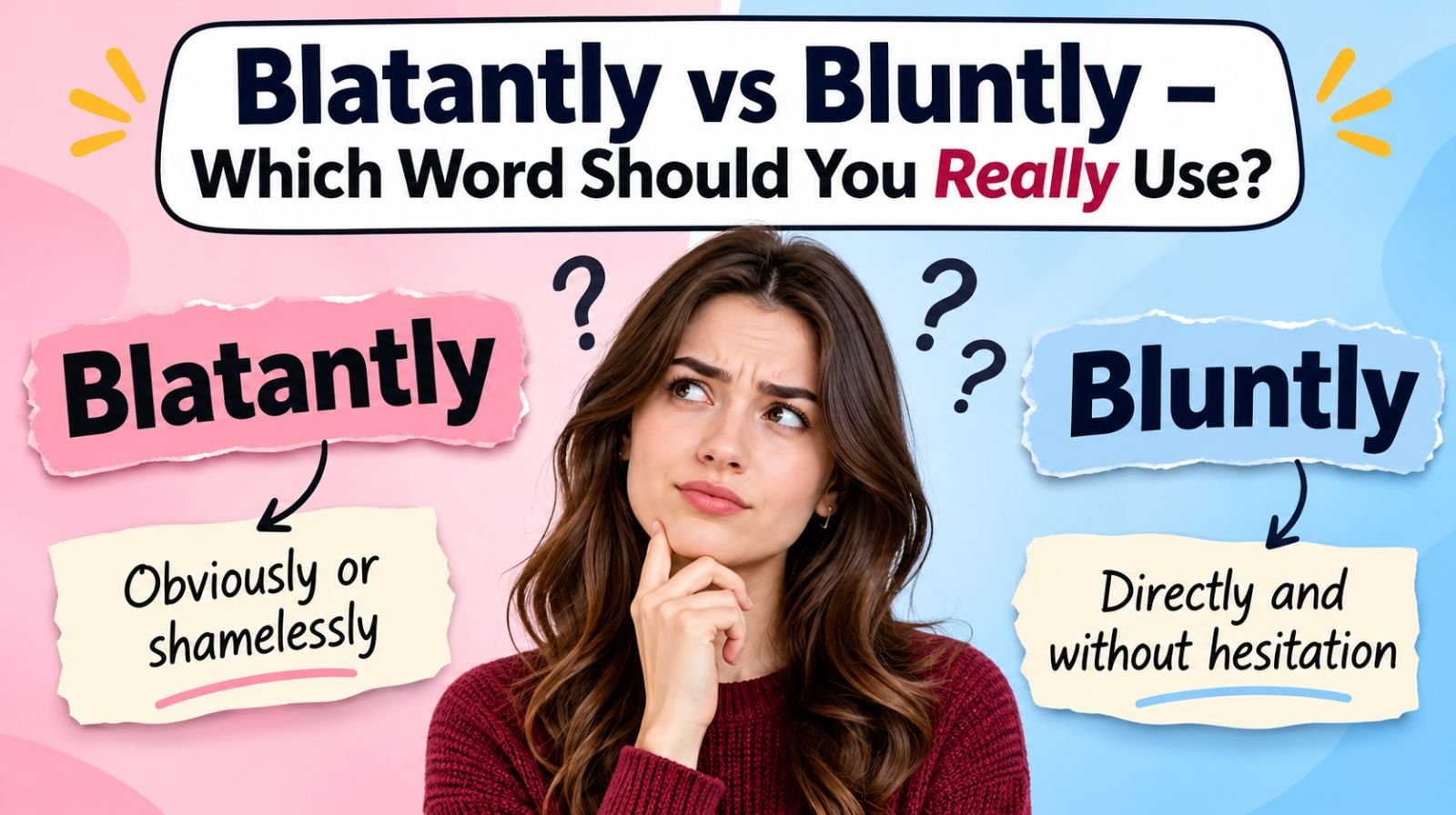
However, they do not communicate the same message. Blatantly describes something done in an obvious, noticeable, or shameless way, while bluntly describes speaking in a direct and straightforward manner without softening your words.
For example, if someone openly ignores a workplace rule, you can say they blatantly ignored the instructions. On the other hand, if a manager tells an employee that their performance is poor without using polite or indirect language, you can say the manager bluntly criticized their performance.
Understanding this difference can help you choose the right word in emails, conversations, professional writing, and everyday communication.
Let’s explore their meanings, differences, examples, and common mistakes so you can use both words confidently.
Blatantly vs Bluntly: Quick Answer

Blatantly means doing something in an obvious, noticeable, or shameless way, especially when the action is clearly wrong, inappropriate, or difficult to ignore.
Bluntly means speaking or expressing something directly and honestly without trying to make your words softer or more pleasant.
Here is a quick comparison:
| Word | Meaning | Example |
|---|---|---|
| Blatantly | Obviously or shamelessly | He blatantly ignored the warning. |
| Bluntly | Directly and without softening words | She bluntly told me the truth. |
Remember this simple distinction:
- Use blatantly when describing an obvious action, violation, lie, or display of behavior.
- Use bluntly when describing direct speech, criticism, opinions, or honest communication.
Both words can carry a negative tone, but their meanings are not interchangeable.
What Does Blatantly Mean?
Blatantly is an adverb that means doing something in an obvious, open, or shameless manner. It is commonly used when someone’s behavior is so noticeable that other people cannot reasonably overlook it.
The word often describes actions that break rules, ignore expectations, show disrespect, or involve dishonesty.
For example:
- The student blatantly cheated during the examination.
- Mark blatantly ignored the company’s safety instructions.
- The politician blatantly denied something that everyone had witnessed.
- She blatantly copied another writer’s work without giving credit.
In these examples, the actions are not hidden or subtle. They happen openly or are so obvious that people can easily recognize them.
When Should You Use Blatantly?
Use blatantly when you want to emphasize that something is clearly happening, especially when the behavior is dishonest, disrespectful, unfair, or against established rules.
Here are some common situations where this word fits naturally.
1. When Someone Clearly Breaks a Rule
Imagine a student using a mobile phone during an examination, even though the teacher has repeatedly warned everyone that phones are prohibited.
You could say:
“The student blatantly ignored the examination rules by using his phone during the test.”
The word blatantly emphasizes that the student knowingly and openly disregarded the rules.
2. When Someone Tells an Obvious Lie
Suppose your colleague tells everyone that he completed a project, but you have clear evidence that he never started working on it.
You might say:
“Daniel blatantly lied about completing the project.”
Here, blatantly highlights the obvious and dishonest nature of his statement.
3. When Someone Shows Disrespect
Imagine attending a business meeting where one employee repeatedly interrupts the manager and refuses to follow basic meeting etiquette.
You could describe the behavior this way:
“He blatantly disrespected the manager during the meeting.”
This sentence emphasizes that the disrespectful behavior was obvious to everyone present.
4. When Someone Ignores Instructions
Consider a workplace situation where a supervisor asks employees to submit their reports by Friday. However, one employee knowingly ignores the deadline without providing an explanation.
You can write:
“James blatantly ignored the supervisor’s instructions and failed to submit his report.”
The word communicates that the employee’s disregard was noticeable and deliberate.
Blatantly in Real-Life Email Examples
Using blatantly in professional emails can help describe obvious problems, violations, or inappropriate behavior. However, remember that it can sound accusatory, so choose your wording carefully.
Email Example 1: Reporting a Workplace Rule Violation
Imagine you are reporting an employee who repeatedly ignores company policies.
Subject: Concern Regarding Workplace Policy Violations
Hi Robert,
I wanted to bring your attention to an issue involving workplace procedures. One of the team members has blatantly ignored the established safety guidelines despite receiving multiple reminders. I believe this situation needs to be addressed before it creates further problems for the team.
Best regards,
Michael
Why is blatantly correct here?
The email describes someone openly disregarding established rules. The word emphasizes the obvious nature of the violation.
Email Example 2: Addressing Plagiarism
Imagine you discover that someone has copied your written content without permission.
Subject: Concern About Unauthorized Content Use
Hi Sarah,
I recently reviewed the article published on your website and noticed that several sections appear to have been taken directly from my original work. It seems that my content has been blatantly copied without proper acknowledgment. I would appreciate it if you could review the matter and take the necessary steps to resolve it.
Regards,
David
Why is blatantly correct here?
The word emphasizes that the copying is obvious and not simply an accidental similarity.
Email Example 3: Discussing an Unfair Decision
Imagine your manager gives an opportunity to one employee despite another employee being more qualified.
Subject: Concern About the Recent Promotion Decision
Hi Amanda,
I wanted to express my concerns regarding the recent promotion decision. Based on the team’s experience and performance records, the selection process appeared unfair. It seemed that the contributions of several qualified employees were blatantly overlooked. I hope we can discuss the decision and understand the reasons behind it.
Best regards,
Christopher
Why is blatantly correct here?
It emphasizes that important contributions were clearly disregarded.
What Does Bluntly Mean?
Bluntly is an adverb that means speaking or expressing something in a direct, straightforward, and sometimes uncomfortably honest manner.
When someone speaks bluntly, they do not spend much time making their words sound polite, gentle, or pleasant. They communicate their thoughts directly, even if the listener might find the message unpleasant.
For example:
- She bluntly told him that his presentation needed improvement.
- My manager bluntly explained why the proposal was rejected.
- To put it bluntly, the project was unsuccessful.
- He bluntly refused to accept the offer.
In these sentences, the focus is on the directness of someone’s communication rather than whether an action is obvious or shameless.
Bluntly does not always mean being rude. Sometimes, people use blunt language because they want to avoid confusion and communicate honestly.
When Should You Use Bluntly?
Use bluntly when describing direct speech, honest opinions, straightforward criticism, or statements that do not include much politeness or emotional cushioning.
Let’s look at some common situations.
1. When Someone Speaks Honestly
Imagine your friend asks whether you like their new business idea. You believe the idea needs significant improvement, so you decide to give an honest answer.
You could say:
“I’ll be blunt: I don’t think this business idea is ready yet.”
Here, blunt means being direct and honest without hiding your actual opinion.
2. When Giving Direct Feedback
Suppose a manager reviews an employee’s presentation and notices several important weaknesses.
The manager might say:
“She bluntly explained that the presentation lacked research and clear objectives.”
The word bluntly describes how the manager delivered the feedback: directly, without making the criticism sound softer.
3. When Refusing an Offer
Imagine someone offers you a business partnership, but you are not interested.
You might respond:
“To put it bluntly, I am not interested in this partnership.”
This expression communicates your decision clearly without unnecessary explanations.
4. When Discussing an Uncomfortable Truth
Suppose your friend continues spending money irresponsibly and asks why they are struggling financially.
You could say:
“To put it bluntly, you need to stop spending more than you earn.”
The word emphasizes that the advice is straightforward, even if the listener might not enjoy hearing it.
Bluntly in Real-Life Email Examples
The word bluntly can be useful in emails when you want to describe direct communication or introduce an honest opinion.
However, using it to describe your own message can sometimes make the email sound more confrontational than necessary.
Here are some practical examples.
Email Example 1: Giving Honest Feedback to a Colleague
Imagine your colleague asks for your opinion about a presentation before sending it to a client.
Subject: Feedback on Your Presentation
Hi Daniel,
Thank you for sharing the presentation with me. I’ll be blunt: the overall structure needs improvement, and some of the information is difficult to follow. I think adding clearer headings and simplifying the slides would make the presentation much stronger. I hope you find this feedback helpful.
Best regards,
Emily
Why is blunt correct here?
The sender is expressing an honest opinion directly instead of hiding the criticism behind overly polite language.
Email Example 2: Explaining Why a Proposal Was Rejected
Imagine you are a team leader explaining why a proposed project cannot move forward.
Subject: Feedback on Your Project Proposal
Hi James,
Thank you for submitting your proposal. To put it bluntly, the current plan does not meet our project requirements. The budget is too high, and the expected results are not clearly explained. I would encourage you to revise the proposal and address these concerns before submitting it again.
Regards,
Olivia
Why is bluntly correct here?
The phrase “To put it bluntly” introduces a direct and honest assessment without unnecessary softening.
Email Example 3: Declining a Business Opportunity
Imagine someone contacts you with a business offer that does not match your company’s goals.
Subject: Regarding Your Partnership Proposal
Hi Robert,
Thank you for considering our company for this opportunity. To be completely blunt, we are not interested in moving forward with this partnership because it does not align with our current business objectives. We appreciate your time and wish you success with your project.
Kind regards,
Sophia
Why is blunt correct here?
The sender communicates a clear decision without creating false expectations.
Blatantly vs Bluntly: Key Differences Explained

Although both words can describe unpleasant situations, they emphasize different things.
The easiest way to understand their difference is to look at what each word modifies.
| Comparison | Blatantly | Bluntly |
|---|---|---|
| Main meaning | Obviously or shamelessly | Directly or frankly |
| Main focus | Noticeable behavior or action | Direct communication |
| Common usage | Ignoring, copying, lying, violating | Speaking, explaining, criticizing |
| Tone | Often strongly negative | Direct, honest, sometimes rude |
| Typical context | Rules, dishonesty, disrespect | Opinions, conversations, feedback |
Difference in Meaning
Blatantly emphasizes how obvious or shameless an action is.
Bluntly emphasizes how directly someone communicates something.
For example:
- He blatantly ignored the warning.
- He bluntly explained why he ignored the warning.
The first sentence focuses on the obvious act of ignoring the warning. The second focuses on how directly he explained his decision.
Difference in Usage
Blatantly is commonly used with actions and behaviors that are clearly inappropriate or dishonest.
Bluntly is commonly used with communication-related verbs such as said, told, explained, refused, admitted, and criticized.
Consider these examples:
- The company blatantly violated the agreement.
- The company bluntly admitted that it had made a mistake.
Both sentences discuss a negative situation, but their meanings are different.
Difference in Tone
Blatantly usually carries a negative meaning because it often describes something clearly wrong, disrespectful, or dishonest.
Bluntly can be negative or neutral depending on the situation. Someone who speaks bluntly might be rude, but they might also simply prefer honest and direct communication.
For instance:
“She blatantly insulted her colleague.”
This suggests openly disrespectful behavior.
“She bluntly told her colleague that the work was incomplete.”
This suggests direct criticism, although the tone might or might not be rude.
Blatantly vs Bluntly: Can You Use Them Interchangeably?
No. Blatantly and bluntly are not interchangeable because they describe different things.
Using one instead of the other can change the meaning of your sentence.
Consider the following examples:
Incorrect for the intended meaning:
“He bluntly ignored the company rules.”
Better:
“He blatantly ignored the company rules.”
The intended meaning is that someone openly disregarded established rules.
Now consider another example:
Incorrect for the intended meaning:
“She blatantly told me that I needed more experience.”
Better:
“She bluntly told me that I needed more experience.”
The intended meaning is that someone delivered an honest and direct statement.
However, context matters. Bluntly can sometimes describe an obvious refusal or rejection, and blatantly can describe a statement when the focus is on how obvious or shameless it is. The key is the meaning you want to communicate.
Common Mistakes to Avoid When Using Blatantly and Bluntly
Even experienced English writers sometimes confuse these words. The following mistakes can help you recognize when to use each one.
1. Using Bluntly to Describe an Obvious Violation
Incorrect: The employee bluntly violated the safety rules.
Better: The employee blatantly violated the safety rules.
Why? The sentence describes an obvious violation rather than direct communication.
2. Using Blatantly to Describe Honest Feedback
Incorrect: My teacher blatantly told me that my writing needed improvement.
Better: My teacher bluntly told me that my writing needed improvement.
Why? The sentence focuses on how directly the teacher delivered the feedback.
3. Assuming Bluntly Always Means Rudely
This is another common misunderstanding.
Someone can speak bluntly without intending to offend anyone. For example:
“To be blunt, I think we should reconsider the project timeline.”
This statement is direct, but it does not necessarily express disrespect.
Blunt communication can be honest without being intentionally hurtful.
4. Assuming Blatantly Only Describes Dishonesty
Although blatantly frequently appears with words such as lied, cheated, and copied, it is not limited to dishonest actions.
For example:
“She blatantly ignored everyone in the room.”
This describes openly noticeable behavior, even though it does not necessarily involve dishonesty.
Easy Tricks to Remember the Difference
If you frequently mix up these words, a simple memory technique can help.
Remember Blatantly Through the Word Obvious
Think of blatantly as something that is impossible to miss.
For example:
- Blatantly cheating.
- Blatantly ignoring.
- Blatantly disrespecting.
- Blatantly copying.
If the situation involves an obvious or shameless action, blatantly is usually the better choice.
Remember Bluntly Through Direct Speech
Think of bluntly as speaking without softening your message.
For example:
- Bluntly speaking.
- Bluntly criticizing.
- Bluntly explaining.
- Bluntly refusing.
If someone communicates directly without choosing gentle or diplomatic language, bluntly is usually appropriate.
Quick memory tip: Blatantly is about obvious behavior, while bluntly is about direct communication.
Frequently Asked Questions
1. Is Blatantly or Bluntly Correct?
Both blatantly and bluntly are correct English words. However, they have different meanings. Blatantly means obviously or shamelessly, while bluntly means directly and without softening your words.
2. What Is the Main Difference Between Blatantly and Bluntly?
The main difference is their focus. Blatantly describes obvious or shameless behavior, whereas bluntly describes direct communication. For example, someone can blatantly ignore a rule or bluntly express an opinion.
3. Does Blatantly Mean Obviously?
Yes. Blatantly often means obviously, openly, or shamelessly. It is commonly used to describe actions that are noticeable and difficult to ignore, especially when they involve dishonesty, disrespect, or rule-breaking.
4. Does Bluntly Mean Rudely?
Not necessarily. Bluntly means speaking directly without trying to make your words softer or more pleasant. Although blunt communication can sometimes sound rude, it can also be honest and straightforward without any intention to offend.
5. Can I Use Bluntly in a Professional Email?
Yes. You can use bluntly in professional emails when you want to describe direct communication or introduce an honest opinion. However, expressions such as “To be direct” or “To be completely honest” may sound more diplomatic in formal business communication.
6. Can Blatantly Be Used in a Positive Sentence?
Blatantly usually carries a negative tone, but its meaning depends on the context. It generally emphasizes something obvious, noticeable, or shameless rather than expressing approval. Therefore, it is more commonly used to describe inappropriate or undesirable behavior.
7. What Is Another Word for Blatantly?
Some alternatives to blatantly include obviously, openly, shamelessly, conspicuously, and flagrantly. The best alternative depends on the context and the strength of the meaning you want to express.
8. What Is Another Word for Bluntly?
Some alternatives to bluntly include directly, frankly, honestly, straightforwardly, and candidly. These words can describe communication that is clear, direct, and not overly softened.
9. Is Bluntly Speaking Grammatically Correct?
Yes. “Bluntly speaking” is a grammatically correct expression used to introduce an honest or direct statement. For example, “Bluntly speaking, this plan needs significant improvement.”
10. What Does To Put It Bluntly Mean?
“To put it bluntly” means expressing something in a direct and straightforward way without trying to make it sound more pleasant. For example, “To put it bluntly, we need a better strategy.”
Conclusion
Understanding the difference between blatantly vs bluntly becomes much easier when you focus on what each word describes.
Use blatantly when talking about something obvious, open, or shameless, particularly when describing dishonest behavior, disrespect, or violations of rules. For example, someone might blatantly ignore instructions, blatantly copy content, or blatantly lie.
Use bluntly when describing direct communication, honest opinions, or straightforward criticism. For example, someone might bluntly explain a problem, bluntly reject an offer, or bluntly tell a friend the truth.
Although both words can describe uncomfortable situations, they serve different purposes in English.
The easiest way to remember their meanings is this: blatantly describes obvious behavior, while bluntly describes direct communication. Keep this distinction in mind, and you will be able to use both words correctly in everyday conversations, professional emails, and formal writing.
Continue learning with simple grammar lessons on Rule Zenix

I’m Muhammad Bilal, the founder of Rule Zenix and a passionate English grammar content creator with one year of experience. I create simple, accurate, and practical guides on grammar, punctuation, vocabulary, and writing to help students, professionals, and English learners improve their communication skills with confidence.