When writing in English, even a small spelling mistake can change the quality of your message. Some words are particularly confusing because they sound similar when spoken, making it easy to leave out a letter without noticing.
Disappoint vs Disapoint is one such spelling confusion that often appears in emails, school assignments, professional documents, and everyday conversations.
If you have ever wondered whether to write disappoint or disapoint, you are not alone. Both spellings may look familiar, but only one is correct in standard English.
The correct spelling is disappoint, with two consecutive P’s. Disapoint is a common misspelling and should be avoided in both formal and informal writing.
In this guide, you will learn the difference between disappoint and disapoint, understand the meaning of the correct word, explore practical examples, and discover simple ways to remember its spelling.
Disappoint vs Disapoint: Which Spelling Is Correct?
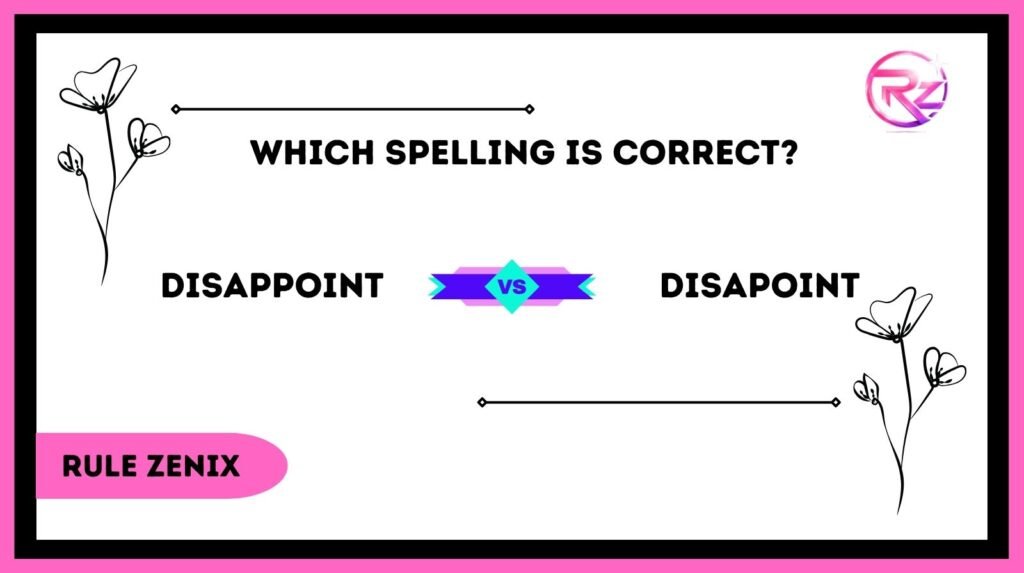
Disappoint is the correct spelling in standard English, while disapoint is incorrect.
The word disappoint means to make someone feel unhappy, dissatisfied, or let down because something did not happen as expected. It can also describe a situation in which someone fails to meet another person’s hopes or expectations.
The confusion usually happens because people pronounce the word without clearly emphasizing both P’s. As a result, they sometimes write only one P instead of two.
Here is a quick comparison:
| Spelling | Correct or Incorrect | Explanation |
|---|---|---|
| Disappoint | Correct | Standard English spelling with two P’s. |
| Disapoint | Incorrect | Common misspelling with one P. |
Remember: Always write disappoint with two P’s. Whether you are sending a professional email, writing an academic assignment, or having a casual conversation, this is the spelling you should use.
What Does Disappoint Mean?
Disappoint is a verb that means to make someone feel sad, unhappy, or dissatisfied when something does not meet their expectations.
It is commonly used when a person, event, decision, or result fails to provide what someone hoped for.
For example, imagine that you have been preparing for an important job interview. You expect to perform well, but unfortunately, you do not get selected. You might say:
“I was disappointed when I did not get the job.”
Here, disappointed describes your feelings after the result did not match your expectations.
Similarly, parents may feel disappointed when their children do not complete their responsibilities, customers may feel disappointed with poor service, and students may feel disappointed after receiving lower grades than expected.
Example Sentences Using Disappoint
Here are some natural examples showing how to use disappoint correctly:
- I do not want to disappoint my parents after everything they have done for me.
- The company promised excellent service but managed to disappoint its customers.
- Please do not disappoint your teammates during the final match.
- Sarah was afraid that her performance would disappoint her manager.
- The movie looked exciting in its trailer but eventually disappointed everyone.
- I hope my decision does not disappoint you.
- Missing the opportunity would disappoint the entire team.
In each sentence, disappoint expresses the idea of failing to meet someone’s expectations or hopes.
Why Is Disapoint Incorrect?
The spelling disapoint is incorrect because it leaves out one of the two P’s required in the standard spelling of the word.
English spelling can sometimes be confusing because pronunciation does not always reveal how many letters a word contains. This is particularly true when two consecutive consonants are pronounced together.
For example, when you say disappoint aloud, you may not notice the double P sound. However, the correct written form always contains both letters.
Compare these two spellings:
- Disappoint: D-I-S-A-P-P-O-I-N-T
- Disapoint: D-I-S-A-P-O-I-N-T
The first spelling contains ten letters, while the second contains nine.
The correct spelling is disappoint, and the incorrect version should not be used in standard English writing.
Common Reasons People Write Disapoint
There are several reasons why people make this spelling mistake.
1. Forgetting the Double P
The most common reason is simply forgetting that disappoint contains two consecutive P’s. Writers may remember the general structure of the word but accidentally leave out one letter.
2. Pronunciation Confusion
Because both P’s are pronounced together, some people assume that only one P is necessary.
3. Typing Too Quickly
Typing quickly on a keyboard or mobile phone can lead to missing letters. This is especially common when writing messages or emails without proofreading.
4. Limited Spelling Practice
People who do not frequently use the word may struggle to remember its correct spelling.
The easiest solution is to remember the double P pattern and check your writing before submitting or sharing it.
How to Use Disappoint in Everyday Writing
The word disappoint is useful in many situations because it helps communicate unmet expectations, dissatisfaction, and emotional reactions.
You can use it in professional communication, academic writing, personal messages, and everyday conversations.
Let’s explore some practical scenarios.
Scenario 1: Using Disappoint in a Professional Email
Imagine that a project manager named Daniel has promised to complete an important project by Friday. Unfortunately, the project is delayed, and he needs to explain the situation to his supervisor.
Here is how he could use the word correctly:
Subject: Update Regarding Project Completion
Hi Mr. Anderson,
I wanted to inform you that the project will require a little more time than originally expected. I understand that this delay may disappoint you, and I sincerely apologize for the inconvenience. Our team is working hard to complete the remaining tasks and deliver the best possible results. Thank you for your patience and understanding.
Best regards,
Daniel
In this example, disappoint communicates the possibility that the supervisor may feel dissatisfied because of the unexpected delay.
Scenario 2: Using Disappoint in a Personal Conversation
Imagine that Emily has promised her friend Olivia that she will attend her birthday party. However, an unexpected family commitment prevents her from attending.
She might send this message:
“Hey Olivia, I’m really sorry, but I won’t be able to make it to your birthday party. I hope I don’t disappoint you. I genuinely wanted to be there and celebrate your special day.”
This example shows how disappoint can be used naturally in an informal conversation.
Scenario 3: Using Disappoint in an Academic Situation
Suppose a student named Michael has prepared for an important examination. His parents have high expectations, and he wants to perform well.
He might write:
“I studied hard for my final examination because I did not want to disappoint my parents. Although the questions were difficult, I tried my best to achieve a good result.”
Here, disappoint expresses the student’s concern about failing to meet his parents’ expectations.
Scenario 4: Using Disappoint in Customer Service
Imagine that a customer named Sophia receives a damaged product after ordering it online.
She could write:
“I am disappointed with the condition of the product I received. I expected better quality and service from your company. I hope you can resolve this issue as soon as possible.”
Although this example uses disappointed rather than disappoint, both forms belong to the same verb family.
Disappoint vs Disappointed: What Is the Difference?
While exploring the spelling of disappoint, you may also come across the word disappointed.
Both words are correct, but they serve different grammatical purposes.
- Disappoint: A verb that describes making someone feel dissatisfied or unhappy.
- Disappointed: The past-tense and past-participle form of disappoint. It is also commonly used as an adjective to describe someone’s feelings.
Consider these examples:
- I do not want to disappoint my teacher.
- I was disappointed with my examination results.
- The team hopes not to disappoint its supporters.
- Sarah felt disappointed when her application was rejected.
The important difference is that disappoint describes the action, while disappointed commonly describes the feeling or the result of that action.
Disappoint vs Disappointment: Understanding the Difference
Another related word worth understanding is disappointment.
Although disappoint and disappointment share the same root, they have different grammatical functions.
Disappoint is a verb, whereas disappointment is a noun.
Disappointment refers to the feeling of sadness or dissatisfaction that occurs when something does not happen as expected.
Here are some examples:
- I never want to disappoint my family.
- Losing the competition was a major disappointment.
- His actions may disappoint his supporters.
- The cancellation of the event caused great disappointment.
Understanding this difference can help you choose the right word when writing sentences.
Easy Tricks to Remember the Correct Spelling of Disappoint
If you frequently forget whether disappoint contains one or two P’s, a few simple spelling tricks can help.
1. Remember the Double P
The easiest way to remember the correct spelling is to focus on the two consecutive P’s.
Write the word as:
DIS + APPOINT = DISAPPOINT
The word appoint already contains two P’s. Adding the prefix dis- gives you disappoint.
This is a useful spelling pattern to remember whenever you write the word.
2. Break the Word Into Smaller Parts
Instead of memorizing the entire word at once, divide it into smaller sections:
- DIS
- APPOINT
When you combine these parts, you get DISAPPOINT.
This technique makes the spelling easier to remember and reduces the chances of leaving out a letter.
3. Practice With Short Sentences
Writing a word several times in meaningful sentences can improve your spelling memory.
Try practicing these examples:
- I do not want to disappoint anyone.
- Never disappoint people who trust you.
- The unexpected result may disappoint the team.
- I hope this decision will not disappoint my friends.
Regular practice will make the correct spelling feel more natural.
Common Mistakes to Avoid When Using Disappoint
Even though disappoint is not particularly difficult to understand, writers sometimes make mistakes when using it.
Here are a few common problems to watch out for.
Using Disapoint Instead of Disappoint
Incorrect: I do not want to disapoint my parents.
Correct: I do not want to disappoint my parents.
Confusing Disappoint With Disappointed
Incorrect: I feel disappoint about the result.
Correct: I feel disappointed about the result.
Confusing Disappoint With Disappointment
Incorrect: His decision caused a lot of disappoint.
Correct: His decision caused a lot of disappointment.
Forgetting to Proofread
Even experienced writers can make small spelling mistakes. Always review your sentences before sending an email, submitting an assignment, or publishing an article.
Synonyms of Disappoint
Sometimes, using the same word repeatedly can make your writing sound less interesting. Learning synonyms can help you express similar meanings in different ways.
Here are some useful alternatives to disappoint:
| Synonym | Meaning |
|---|---|
| Let down | To fail to meet someone’s expectations. |
| Dishearten | To reduce someone’s confidence or enthusiasm. |
| Upset | To make someone unhappy or distressed. |
| Dissatisfy | To fail to meet someone’s needs or expectations. |
| Frustrate | To prevent someone from achieving what they want. |
| Discourage | To reduce someone’s hope or motivation. |
For example:
- I do not want to let down my friends.
- The unexpected result may dishearten the players.
- Poor customer service can dissatisfy customers.
These alternatives can make your writing more varied while helping you communicate your ideas clearly.
Frequently Asked Questions
1. Is Disappoint or Disapoint Correct?
Disappoint is the correct spelling in standard English. Disapoint is a common misspelling because it leaves out one of the two P’s. Always use disappoint in formal and informal writing.
2. How Do You Spell Disappoint?
The correct spelling is D-I-S-A-P-P-O-I-N-T. It contains ten letters, including two consecutive P’s. Remembering the double P can help you avoid common spelling mistakes.
3. Is Disapoint a Real Word?
No. Disapoint is not the standard English spelling of the word disappoint. It is generally considered a spelling mistake and should be corrected when writing.
4. What Does Disappoint Mean?
Disappoint means to make someone feel unhappy, dissatisfied, or let down because something does not meet their expectations. For example, failing to attend an important event may disappoint a close friend.
5. Why Does Disappoint Have Two P’s?
Disappoint contains two P’s because it is formed by combining the prefix dis- with appoint. Since appoint already contains two P’s, the complete word disappoint retains both letters.
6. What Is the Past Tense of Disappoint?
The past-tense form of disappoint is disappointed. For example: “The unexpected news disappointed everyone.” It is formed by adding -ed to the base verb.
7. Is Disappointed a Correct Word?
Yes, disappointed is a completely correct English word. It describes someone who feels unhappy or dissatisfied because something did not happen as expected.
8. What Is the Difference Between Disappoint and Disappointment?
Disappoint is a verb that describes the action of making someone unhappy or dissatisfied. Disappointment is a noun that describes the feeling of sadness or dissatisfaction caused by unmet expectations.
9. Can I Use Disappoint in a Formal Email?
Yes. Disappoint is appropriate for professional emails, business communication, academic writing, and other formal situations. For example, “I apologize if this unexpected delay disappoints you.”
10. How Can I Remember the Spelling of Disappoint?
Remember that disappoint contains two P’s because the word appoint already has two P’s. Breaking it into DIS + APPOINT is an easy way to memorize its correct spelling.
Conclusion
When comparing disappoint vs disapoint, the correct choice is always disappoint in standard English. The spelling disapoint is incorrect because it contains only one P instead of the required double P.
Disappoint is a useful verb that describes making someone feel unhappy, dissatisfied, or let down when expectations are not met. You can use it in everyday conversations, professional emails, academic assignments, and many other writing situations.
To avoid this common spelling mistake, remember the simple pattern DIS + APPOINT = DISAPPOINT. With a little practice and careful proofreading, you can use the word confidently and keep your writing clear, accurate, and professional.
Discover More Article
- Yea or Nay: Meaning, Usage, And Examples In US English
- Heros or Heroes: Correct Spelling And Usage Explained
- Occurring or Occuring: Simple Spelling Difference Explained Clearly
- Ensure or Insure: What’s The Difference?
- Elude or Allude? Which Word Should You Use?
- Whisky or Whiskey: Which Spelling Should You Use?
- Exhilarate vs Exhilirate: Correct Spelling And Usage Guide
Continue learning with simple grammar lessons on Rule Zenix

I’m Muhammad Bilal, the founder of Rule Zenix and a passionate English grammar content creator with one year of experience. I create simple, accurate, and practical guides on grammar, punctuation, vocabulary, and writing to help students, professionals, and English learners improve their communication skills with confidence.