Have you ever written “more then” and wondered whether it should actually be “more than”? You’re not alone. These two words sound similar, but they have different meanings and grammatical jobs.
When talking about a comparison or quantity, “more than” is the correct phrase. “More then” is generally incorrect when you are trying to compare two things.
The good news is that the difference between more then and more than is simple once you understand what than and then mean.
Let’s break it down with clear explanations, examples, and an easy memory trick.
More Than or More Then: Which Is Correct?
The correct phrase is “more than” when you are making a comparison or talking about an amount that exceeds another amount.
What Does “More Than” Mean?
More than means a greater amount, number, degree, or quantity compared with something else.
For example:
- Sarah has more than 20 books.
- This box weighs more than 10 pounds.
- I have known him for more than five years.
- The movie lasted more than two hours.
In each sentence, than introduces a comparison involving a greater amount.
What Does “More Then” Mean?
Then usually relates to time, sequence, or what happens next.
For example:
- We ate dinner, then watched a movie.
- Finish your homework, then you can play.
- I lived there then, but I moved later.
Therefore, “more then” is normally a spelling or word-choice mistake when the intended meaning is a comparison.
Quick Answer for “More Then or More Than”
If you’re comparing amounts, numbers, people, things, or degrees, use more than.
Correct: I have more than $50.
Incorrect: I have more then $50.
A simple rule is: Comparison = than. Sequence/time = then.
The Difference Between Than and Then
Understanding the individual words makes the phrase much easier to remember.
When to Use “Than”
Use than when comparing two things or showing that one amount is greater or smaller than another.
Examples:
- My car is faster than yours.
- She is taller than her brother.
- We need more than 100 chairs.
- This book is better than the previous one.
- He earns more than I do.
The word than commonly appears after comparative words such as more, less, better, faster, and higher.
When to Use “Then”
Use then when talking about a time, sequence, or result.
Examples:
- First, wash your hands, then prepare the food.
- I was younger then.
- If you finish early, then you can leave.
- We went to the store and then came home.
A useful way to think about it is:
Than = comparison
Then = time or sequence
Why People Confuse “Then” and “Than”
The confusion happens because then and than are pronounced similarly in many varieties of English. Their spelling differs by only one letter, so typing quickly can easily lead to mistakes.
For example, someone might write:
“There were more then 50 people at the event.”
The intended meaning is clearly a comparison of quantity. Therefore, the correct sentence is:
“There were more than 50 people at the event.”
How to Use “More Than” Correctly
Once you know that than is used for comparison, using “more than” becomes straightforward.
More Than With Numbers
Use more than when one quantity exceeds another.
Examples:
- More than 500 people attended.
- The article has more than 2,000 words.
- She has more than 10 years of experience.
- The package costs more than $100.
More Than With Time
“More than” can also describe a period that exceeds a particular amount of time.
Examples:
- I waited for more than an hour.
- They have been married for more than 20 years.
- The project took more than three months.
Notice that more than remains correct because the phrase expresses an amount exceeding a specific point.
More Than in Comparisons
“More than” can compare qualities or degrees as well.
Examples:
- He is more experienced than his colleague.
- This task is more difficult than I expected.
- She is more interested in writing than editing.
Here, than introduces the thing being compared.
“More Than” vs. “More Then” Examples
The fastest way to understand the difference is to see the two words in context.
Correct Examples With “More Than”
- I have more than enough time.
- The building is more than 100 years old.
- She received more than 50 applications.
- This laptop costs more than mine.
- He has traveled to more than 15 countries.
Incorrect “More Then” Examples
These sentences use then where than is needed:
- ❌ I have more then enough time.
- ❌ The building is more then 100 years old.
- ❌ She received more then 50 applications.
- ❌ This laptop costs more then mine.
- ❌ He has traveled to more then 15 countries.
The corrected versions all use more than because they express comparison or quantity.
An Easy Trick to Remember Than vs. Then

If you regularly mix up than and then, try this simple memory trick.
Remember: “Than” Is for Comparing
Think:
Than = comparison
Whenever you are comparing two things or describing a greater or smaller amount, choose than.
Examples:
- bigger than
- smaller than
- better than
- more than
- less than
Remember: “Then” Is for Time
Think:
Then = next or at that time
Examples:
- First this, then that.
- Now and then.
- Back then.
- If this happens, then we will respond.
This quick association can prevent many common spelling and grammar mistakes.
A Real-Life Example: Why “More Than” Matters
Imagine you are writing a business report about website traffic. You want to say that your website received a greater number of visitors than expected.
You write:
“Our website received more then 10,000 visitors last month.”
At first glance, the sentence may look fine because then sounds similar to than. However, the sentence is comparing the number of visitors with 10,000. The correct word is therefore than:
“Our website received more than 10,000 visitors last month.”
This small spelling mistake may seem insignificant in casual conversation, but it can affect the professionalism of formal writing.
Imagine seeing “more then” repeatedly in a business proposal, academic assignment, resume, or website article. Readers may question the writer’s attention to detail.
Now consider another situation:
“We reviewed the report, then updated the figures.”
Here, then is correct because it describes the sequence of events. First, the report was reviewed. Then, the figures were updated.
The difference becomes clear when you ask what the sentence is doing. Is it comparing something, or is it telling you what happens next?
If it is a comparison, use than. If it describes a sequence or time, use then.
More Than vs. More Then: Quick Comparison
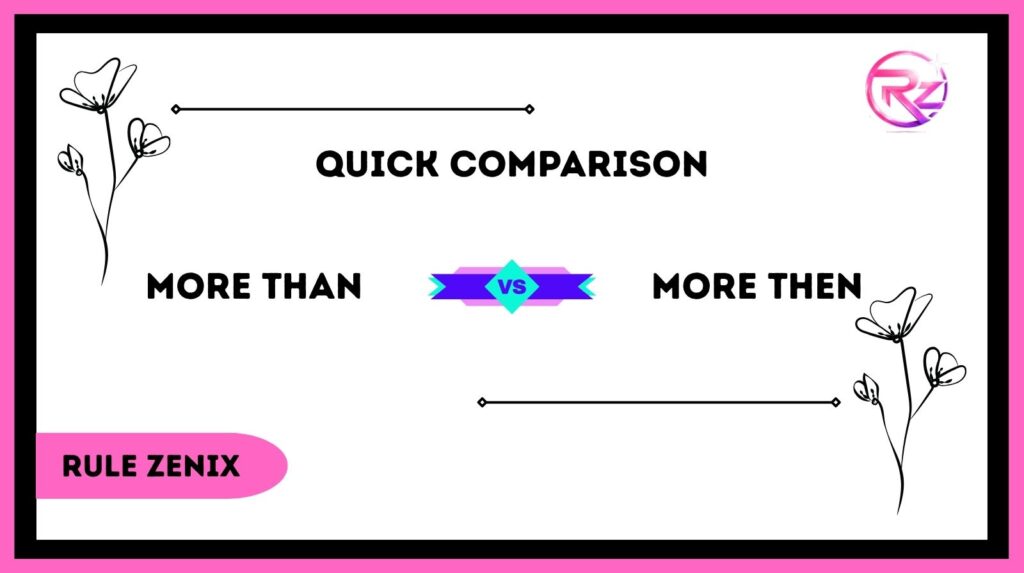
| Word/Phrase | Main Use | Example |
|---|---|---|
| More than | Comparison or greater quantity | She has more than 20 books. |
| Then | Time or sequence | We ate, then left. |
| Than | Comparison | He is taller than me. |
| More then | Usually an incorrect form when comparison is intended | ❌ More then 20 people |
The easiest rule is:
If you’re comparing, choose “than.” If you’re talking about what happens next, choose “then.”
2025–2026 Data and Why Grammar Accuracy Still Matters
Grammar and spelling remain important in digital communication, education, professional writing, and online publishing.
Search engines increasingly focus on helpful, people-first content and overall page quality rather than simply rewarding pages that repeat keywords.
For writers, this means small language choices still matter. A sentence such as “more then 100 people” can make otherwise useful content look less polished, while “more than 100 people” communicates the intended meaning clearly.
Current writing and search-quality guidance also emphasizes creating useful content for people rather than producing text primarily to manipulate search rankings.
For that reason, understanding common word-choice errors such as than vs. then is valuable for anyone creating content in 2025–2026.
The practical takeaway is simple: accurate grammar improves clarity, readability, and reader confidence.
Mini Quiz: More Then or More Than
1. Quick Check: Which One Is Correct?
Question: I have ___ 20 books.
A) more then
B) more than
Answer: B) more than
2. Can You Spot the Right Word?
Question: Which sentence is correct?
A) She has more then $50.
B) She has more than $50.
Answer: B) She has more than $50.
3. Comparison Time!
Question: “Than” is mainly used for what?
A) Time or sequence
B) Comparison
Answer: B) Comparison
4. Then or Than?
Question: We need ___ 100 chairs for the event.
A) more then
B) more than
Answer: B) more than
5. A Tiny Grammar Challenge
Question: Which word completes the sentence?
“Ali is taller ___ his brother.”
A) then
B) than
Answer: B) than
6. What Happens Next?
Question: Which sentence uses then correctly?
A) We had dinner, then watched a movie.
B) We had more then dinner.
Answer: A) We had dinner, then watched a movie.
7. Fill the Gap!
Question: “I waited for ___ an hour.”
A) more then
B) more than
Answer: B) more than
8. Catch the Common Mistake
Question: Which sentence contains the mistake?
A) He earns more than me.
B) He earns more then me.
Answer: B) He earns more then me.
9. Memory Trick Challenge
Question: Which is the easiest rule to remember?
A) Than = comparison
B) Then = comparison
Answer: A) Than = comparison
10. Pick the Polished Sentence
Question: Choose the correct version:
A) The movie lasted more then two hours.
B) The movie lasted more than two hours.
Answer: B) The movie lasted more than two hours.
11. Grammar Speed Round
Question: Which word fits?
“This book is better ___ that one.”
A) then
B) than
Answer: B) than
12. Can You Get This One?
Question: Choose the correct sentence:
A) More than 500 people attended.
B) More then 500 people attended.
Answer: A) More than 500 people attended.
13. Time or Comparison?
Question: “First finish your work, ___ take a break.”
A) than
B) then
Answer: B) then
14. One Last Comparison!
Question: Which phrase correctly shows a greater amount?
A) more then 10
B) more than 10
Answer: B) more than 10
15. Final Boss: Than or Then?
Question: Complete the sentence:
“She has known him for ___ five years.”
A) more then
B) more than
Answer: B) more than
FAQs
Is “more then” correct?
Usually, no. When you are comparing amounts or saying that something exceeds a particular number, the correct phrase is “more than.”
Is it “more then 10” or “more than 10”?
The correct form is “more than 10.”
Example:
There are more than 10 people in the room.
What is the difference between “than” and “then”?
Than is mainly used for comparisons, while then is commonly used for time, sequence, or results.
Example:
She is older than me.
We ate dinner then watched TV.
Why do people write “more then”?
People often confuse then and than because their pronunciation is similar. Typing quickly can also lead to this common error.
Is “more than” grammatically correct?
Yes. More than is a standard and widely used phrase for expressing a greater amount, number, degree, or comparison.
How can I remember “than” vs. “then”?
Use this simple reminder:
Than = comparison.
Then = time or sequence.
If you’re saying something is greater, smaller, better, faster, or otherwise being compared, than is usually the right choice.
Final Takeaway
So, more then or more than—which is correct? In comparison sentences, the correct phrase is more than.
Use than when comparing amounts, numbers, qualities, or things:
She has more than 50 books.
Use then when talking about time or sequence:
We finished dinner, then went home.
Once you remember “than = comparison” and “then = time or sequence,” this common mistake becomes much easier to avoid.
Discover More Article
- First Cousin Once Removed vs Second Cousin: What’s The Difference?
- Fiance or Fiancee: Difference And Correct Usage
- Totalling or Totaling: Which Spelling Should You Use?
- Flys or Flies: Which Spelling Is Correct?
- Capital or Capitol: Which Word Is Correct?
- Setup or Set Up: Which Is Correct?
Continue learning with simple grammar lessons on Rule Zenix

I’m Muhammad Bilal, the founder of Rule Zenix and a passionate English grammar content creator with one year of experience. I create simple, accurate, and practical guides on grammar, punctuation, vocabulary, and writing to help students, professionals, and English learners improve their communication skills with confidence.