Have you ever wondered whether to write well being or wellbeing? Both forms appear in everyday writing, workplace discussions, health articles, and educational materials.
However, choosing the right spelling can sometimes be confusing, especially when you want your writing to look professional.
The good news is that well-being and wellbeing are both accepted spellings, although their usage can vary depending on the style guide, publication, or context.
The hyphenated form, well-being, is widely established in standard English, while wellbeing is also common, particularly in British English and modern health-related writing.
In this guide, you will learn what these terms mean, how they differ, when to use each spelling, and how to avoid common mistakes. By the end, you will be able to choose the most suitable form for your writing with confidence.
What Does Well-Being or Wellbeing Mean?
Both well-being and wellbeing refer to a person’s overall state of health, happiness, comfort, and quality of life. The term covers more than simply being free from illness. It can also include emotional stability, mental health, social relationships, and financial security.
Understanding the Meaning of Well-Being
Well-being describes how well someone is doing physically, mentally, and emotionally. It can relate to personal happiness, a sense of purpose, safety, and satisfaction with life.
For example:
- Regular exercise can improve your physical well-being.
- Spending time with friends may support your emotional well-being.
- A healthy work environment can contribute to employee well-being.
In each sentence, the term refers to an aspect of a person’s overall health or quality of life.
Is Wellbeing Different in Meaning?
No. In ordinary usage, wellbeing has the same meaning as well-being. The difference is primarily spelling rather than definition.
For example:
- The school prioritizes student well-being.
- The school prioritizes student wellbeing.
Both sentences communicate the same idea. The best choice depends on the spelling convention you follow and the expectations of your audience.
Why Is the Term Important?
Well-being is useful because it describes several connected aspects of life rather than focusing on one condition alone. Someone may be physically healthy but experience emotional stress, for instance.
The term helps writers discuss a person’s overall circumstances, including:
- Physical health and energy
- Mental and emotional balance
- Social connections and relationships
- Personal satisfaction and happiness
- A sense of safety and purpose
Therefore, understanding the term can help you communicate clearly in health, education, workplace, and everyday contexts.
Well Being vs. Wellbeing: Which Spelling Is Correct?
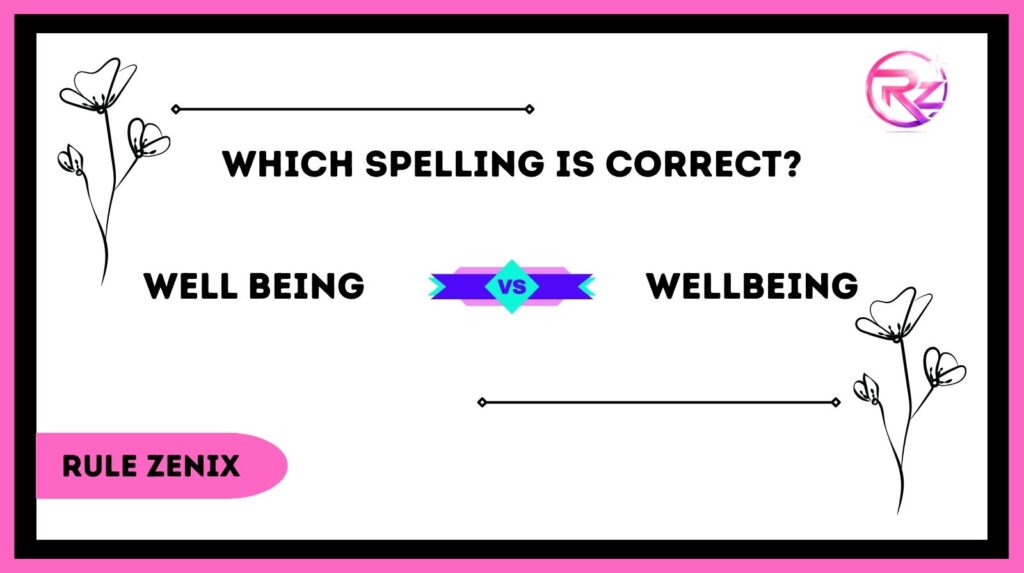
The most established traditional spelling is well-being, with a hyphen. However, wellbeing, written as one word, is also accepted in contemporary English.
The two-word form, well being, is less conventional when referring to the general concept of health and happiness. Although readers will often understand it, the hyphenated or closed form is usually a better choice in edited writing.
When to Use Well-Being
Use well-being when you want a widely recognized spelling that works in formal writing, academic assignments, professional communication, and general publications.
Examples:
- The organization provides resources to support employee well-being.
- Sleep plays an important role in mental well-being.
- The government introduced programs to improve public well-being.
This form is especially useful when your workplace, school, or publication follows a style guide that prefers hyphenated compounds.
When to Use Wellbeing
Use wellbeing when the style guide you follow accepts or prefers the closed spelling. It is common in British English contexts and in some organizations, health publications, and institutional writing.
Examples:
- The university offers a student wellbeing service.
- The campaign promotes community wellbeing.
- The company has introduced a new employee wellbeing program.
The important point is consistency. If you choose wellbeing, avoid switching repeatedly between it and well-being in the same document unless you are following a specific editorial requirement.
Is Well Being Correct as Two Words?
When you mean overall health and happiness, well being is generally less standard than well-being or wellbeing.
However, the words well and being can appear next to each other in a sentence when they have separate grammatical functions.
For example:
- Being well is important for your happiness.
- She is well, being supported by her family.
These examples have different grammatical structures. They do not use well being as the conventional noun for overall health and happiness.
Quick answer: Choose well-being for a broadly recognized standard spelling, or wellbeing if your preferred style guide uses it.
How to Use Well-Being and Wellbeing in Sentences
Both spellings can describe physical, emotional, social, and professional aspects of life. The surrounding words help readers understand exactly which area of well-being you mean.
Examples of Physical and Mental Well-Being
Use the term when discussing health, stress, rest, or emotional balance.
- Drinking enough water supports physical well-being.
- Meditation can help improve mental well-being.
- Getting adequate sleep is essential for overall wellbeing.
- Regular physical activity may benefit emotional well-being.
These examples show how the word can describe different parts of a person’s health and daily life.
Examples in Education and the Workplace
The term is also common in schools, universities, and businesses.
- Teachers should consider the well-being of their students.
- The school introduced a wellbeing program for young learners.
- Flexible working hours can support employee well-being.
- The manager wants to improve staff wellbeing.
In these contexts, the word often refers to conditions that help people feel safe, supported, healthy, and productive.
Examples in Everyday Conversation
You do not need to work in healthcare or education to use the term. It also fits naturally into everyday writing.
- Spending time outdoors improves my sense of well-being.
- Her family’s support contributed to her overall wellbeing.
- Financial stability can influence a person’s well-being.
- Taking regular breaks is good for your wellbeing.
These sentences illustrate why the term is useful when discussing a person’s general quality of life.
Key Differences Between Well Being and Wellbeing
Although the spellings look different, they generally communicate the same meaning. The main distinction is how the compound is written and which spelling convention a writer chooses.
A Quick Comparison
| Feature | Well-being | Wellbeing | Well being |
|---|---|---|---|
| Spelling | Hyphenated | One word | Two separate words |
| Meaning | Overall health and happiness | Overall health and happiness | Less conventional for this meaning |
| General acceptance | Widely established | Accepted in modern usage | Usually not preferred |
| Formal writing | A reliable choice | Suitable when the style guide permits it | Best avoided for the noun |
| Example | Mental well-being matters. | Mental wellbeing matters. | Prefer one of the first two forms. |
American English vs. British English
American and British English can differ in their preferences for spelling and compound words. However, the distinction between well-being and wellbeing is not an absolute rule separating the two varieties.
The hyphenated form is well established in both American and British English. The closed form is also used, particularly in British English and in organizational or institutional writing.
For example:
- American English: The program supports employee well-being.
- British English: The service promotes student wellbeing.
These are reasonable examples of common preferences, not exclusive national rules. American writers may also encounter wellbeing, and British writers may use well-being.
Which Form Should You Choose?
Use this simple checklist before publishing your writing:
- Check your style guide: Follow the spelling required by your school, employer, or publisher.
- Choose a consistent form: Use either well-being or wellbeing throughout the same document.
- Prefer the established hyphenated spelling when unsure: Well-being is a safe choice for general and formal writing.
- Avoid the two-word noun form: Write well-being or wellbeing when referring to overall health and happiness.
This approach keeps your writing clear without treating a legitimate spelling variation as a spelling error.
Real-Life Example: Choosing the Right Spelling at Work
Imagine that a company is preparing a new employee handbook. The document will explain how workers can maintain a healthy balance between their professional responsibilities and personal lives.
During the drafting process, one writer uses the heading “Employee Well Being,” another writes “Employee Well-Being,” and a third suggests “Employee Wellbeing.”
All three headings are understandable, but the editorial team needs to select one form for the final document. The team checks its internal writing guidelines and discovers that they use the hyphenated form in formal policies.
The editor therefore chooses “Employee Well-Being” as the heading. The handbook then uses the same spelling in sections about mental health support, flexible schedules, workplace stress, and access to wellness resources.
This decision does not mean that wellbeing is incorrect. Instead, the company has selected a consistent spelling that matches its preferred editorial style.
Later, the marketing team creates a separate webpage for a wellbeing initiative. Because its existing campaign materials use wellbeing as one word, the team keeps that spelling throughout the webpage.
This example demonstrates an important writing principle: consistency and context matter more than assuming that one accepted spelling is always wrong. When writing for a particular organization, follow its established style. When no style guide exists, well-being is a dependable default.
Well-Being Statistics: Why the Concept Matters
Well-being is more than a spelling question. It is an important concept in public health, employment, education, and everyday life. Research into mental health, life satisfaction, and working conditions helps explain why people and organizations pay attention to it.
Understanding the Data on Well-Being
Well-being is measured in different ways, so there is no single statistic that captures every aspect of it. Researchers may examine life satisfaction, emotional health, social relationships, physical health, or psychological distress.
For example, mental health data can help explain one important component of overall well-being.
The World Health Organization has reported that approximately one in eight people worldwide were living with a mental disorder in 2019.
This is a historical global estimate, not a new measurement for 2025 or 2026. It nevertheless illustrates the scale of mental health challenges that can affect people’s daily lives.
Mental health is only one part of well-being, so this figure should not be interpreted as a measurement of the proportion of people with poor overall well-being.
Why Well-Being Research Matters
Well-being research can help schools, employers, healthcare professionals, and policymakers identify areas where people may need support.
For instance:
- Employers can evaluate workplace stress and employee satisfaction.
- Schools can assess student belonging, safety, and emotional support.
- Public health programs can examine mental health needs.
- Individuals can reflect on sleep, relationships, physical activity, and life satisfaction.
These measurements are useful because they help turn a broad concept into specific areas that can be studied and improved.
What About 2025–2026 Data?
A recent statistic should always be checked against the original report, its publication date, and the population measured.
A global mental health estimate, a national life-satisfaction survey, and an employee wellbeing poll measure different things and cannot be treated as interchangeable.
Rather than presenting an unverified 2025–2026 figure as fact, use a clearly dated source and describe precisely what it measures. This is especially important when discussing well-being trends, since results can vary by country, age group, and research method.
Frequently Asked Questions
Is Well-Being One Word or Two?
Well-being is written as one compound with a hyphen, while wellbeing is written as one closed word. Both are accepted spellings. The two-word form well being is generally less standard when used as a noun meaning overall health and happiness.
Is Wellbeing Grammatically Correct?
Yes. Wellbeing is an accepted spelling in contemporary English. However, some style guides prefer well-being. Follow your publication’s guidelines and use one form consistently.
Is Well-Being More Correct Than Wellbeing?
Not universally. Well-being is a widely established spelling and a reliable choice when you are unsure. Wellbeing is also accepted, and the preferred form may depend on the style guide or publication.
Should I Use Wellbeing in American English?
You can use wellbeing in American English, but well-being is a familiar and widely accepted choice. For formal American writing, check the relevant dictionary or style guide.
What Is the Difference Between Well-Being and Wellness?
Well-being generally refers to a person’s overall state of health, happiness, and quality of life. Wellness often emphasizes the active pursuit or maintenance of good health through habits and lifestyle choices. Their meanings overlap, and the distinction depends on context.
Can I Write Well Being in a Formal Essay?
It is better to use well-being or wellbeing when the noun refers to overall health and happiness. Choose the form recommended by your school or university’s style guide.
Conclusion:
When deciding between well being and wellbeing, remember that well-being and wellbeing are both accepted spellings for a person’s overall health, happiness, and quality of life. The hyphenated form is widely established, while the closed form is also common in modern English.
If you are unsure which spelling to choose, use well-being. It is a dependable option for academic assignments, professional documents, blog posts, and everyday writing.
If your organization or preferred style guide uses wellbeing, that form is appropriate too.
The most important rule is to choose a spelling that suits your audience and use it consistently. Once you understand the difference, you can write about mental health, physical health, and overall well-being with greater confidence.
Discover More Article
- Matt or Mat: Correct Spelling, Meaning, And Usage
- Farther or Further: Which Word Is Correct In American English?
- Either or Neither: Difference, Meaning & Usage
- Yea or Nay: Meaning, Usage, And Examples In US English
- Heros or Heroes: Correct Spelling And Usage Explained
- Me Either or Me Neither: Which One Is Correct?
- Occurring or Occuring: Simple Spelling Difference Explained Clearly
Continue learning with simple grammar lessons on Rule Zenix

I’m Muhammad Bilal, the founder of Rule Zenix and a passionate English grammar content creator with one year of experience. I create simple, accurate, and practical guides on grammar, punctuation, vocabulary, and writing to help students, professionals, and English learners improve their communication skills with confidence.