Have you ever wondered whether the correct spelling is ability or abillity? You are not alone. Many English learners and even experienced writers sometimes add an extra letter when spelling certain words.
This confusion often happens because English contains many words with double consonants, making it difficult to remember which words need one letter and which need two.
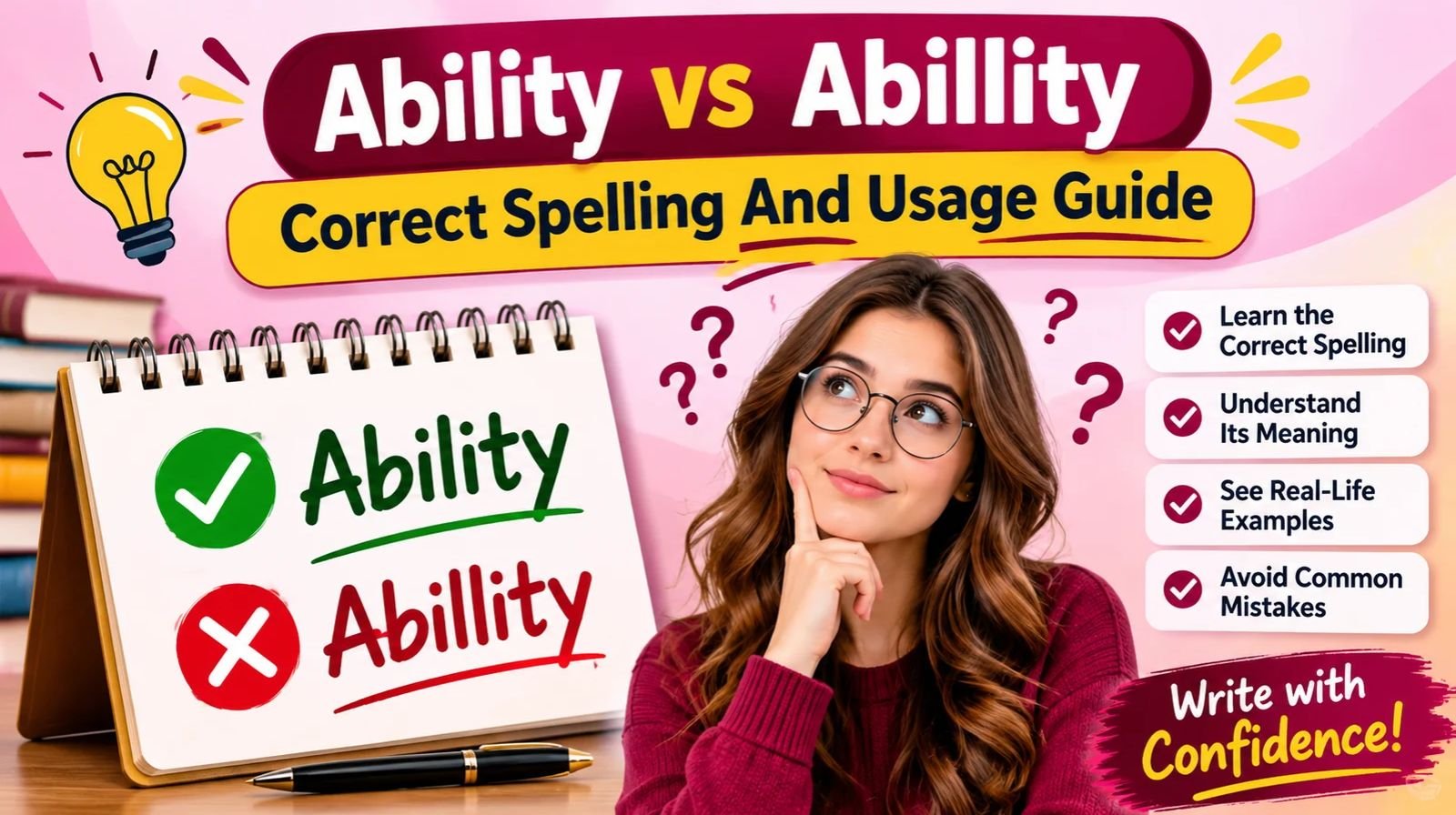
When it comes to these two spellings, however, there is a clear answer: ability is the correct spelling, while abillity is a common misspelling.
The word ability is used in everyday conversations, professional emails, academic writing, job applications, and many other situations. It describes someone’s power, skill, or capacity to do something successfully.
In this guide, you will learn the difference between ability and abillity, understand the meaning of the correct word, explore practical examples, and discover simple tricks to remember its spelling. Let’s get started!
Ability vs Abillity: Which Spelling Is Correct?
The correct spelling is ability, with only one letter L. The spelling abillity, with two Ls, is incorrect in standard English.
Although both versions may look similar, only one is accepted as the standard spelling in dictionaries and formal writing.
Here is a quick comparison:
| Word | Correct or Incorrect | Explanation |
|---|---|---|
| Ability | Correct | Standard English spelling |
| Abillity | Incorrect | Contains an unnecessary extra L |
Ability is a noun that describes someone’s skill, talent, competence, or capacity to perform a particular action.
For example:
- Sarah has the ability to solve difficult mathematical problems.
- His communication ability makes him an excellent team leader.
- The company values employees who have the ability to work independently.
On the other hand, abillity is simply a spelling mistake. You should avoid using it in school assignments, professional documents, business emails, and other forms of writing.
What Does Ability Mean?
The word ability refers to the power, skill, talent, or capacity to do something. It can describe something a person has learned, something they naturally do well, or something they are capable of accomplishing.
In simple words, if someone can perform a task successfully, they have the ability to do it.
For example, a person who can speak several languages has a language ability. Someone who can manage a team effectively has leadership ability.
Ability can also describe physical, mental, creative, and professional skills.
Here are some common types of ability:
1. Physical Ability
Physical ability refers to someone’s capacity to perform activities using their body, strength, coordination, or movement.
Examples:
- The athlete has the ability to run long distances.
- Regular exercise can improve your physical ability.
- Despite his age, Daniel still has the ability to swim for several hours.
Real-life scenario:
Imagine a school sports competition where students participate in different activities. A coach notices that Emma can run faster than most other students.
The coach might say:
“Emma has an excellent physical ability, and she could become a successful athlete with regular training.”
2. Mental Ability
Mental ability describes someone’s capacity to think, understand, remember, learn, and solve problems.
Examples:
- Children develop their mental abilities through learning and practice.
- Her ability to understand complex information is impressive.
- Good reading habits can improve your mental ability.
Real-life scenario:
Suppose a teacher gives students a challenging mathematics problem. Most students struggle to find the answer, but Noah solves it quickly.
His teacher might say:
“Noah has a strong ability to understand mathematical concepts.”
3. Professional Ability
Professional ability refers to the skills and knowledge someone uses to perform their job effectively.
Examples:
- The manager appreciated Olivia’s ability to lead a team.
- Employers look for candidates with strong communication abilities.
- His technical ability helped the company complete the project successfully.
Real-life scenario:
Imagine that a company is hiring a new marketing manager. During the interview, the employer asks about the candidate’s previous experience.
The candidate responds:
“I believe my ability to manage projects, communicate with clients, and develop marketing strategies makes me suitable for this position.”
4. Creative Ability
Creative ability refers to someone’s capacity to produce original ideas, designs, artwork, or solutions.
Examples:
- Her artistic ability makes her paintings unique.
- The designer has an excellent ability to create attractive websites.
- Creative ability can help people find new solutions to everyday problems.
Real-life scenario:
A graphic design company is working on a new advertising campaign. One designer suggests an original concept that impresses the entire team.
The creative director says:
“Your ability to think outside the box has made this campaign much stronger.”
What Does Abillity Mean?
Abillity is not the correct spelling of the English word. It is a common spelling error that occurs when writers accidentally add an extra L.
The mistake may happen because English has many words containing double letters, such as:
- Different
- Excellent
- Intelligent
- Collection
- Brilliant
Because of these words, some people mistakenly assume that ability should also contain two Ls.
However, the standard spelling is always ability.
For example:
Incorrect
“She has the abillity to communicate effectively.”
Correct
“She has the ability to communicate effectively.”
Remember that adding an extra letter can make your writing look unprofessional, particularly in formal communication.
Why Do People Confuse Ability and Abillity?
There are several reasons why people make this spelling mistake. Understanding these reasons can help you avoid repeating it.
1. Confusion About Double Letters
English spelling can be confusing because some words contain double consonants while others do not.
For example:
- Brilliant
- Skill
- Still
- Ability
Writers who are familiar with words containing double Ls may accidentally write abillity instead of ability.
However, ability contains only one L.
2. Pronunciation and Spelling Differences
The pronunciation of a word does not always make its spelling obvious. When people hear ability, they may not immediately remember how many letters are used in its written form.
This is especially common among English learners who are still developing their vocabulary and spelling skills.
The best approach is to learn the correct written form and practice using it in sentences.
3. Typing Mistakes
Sometimes, the problem is not a lack of English knowledge. It is simply a typing mistake.
For example, someone writing quickly on a computer or mobile phone may accidentally press the L key twice.
Even experienced writers can make these mistakes, which is why proofreading is important.
Ability vs Abillity: Examples in Everyday Sentences
The easiest way to understand the correct spelling is to see how the word ability works in different situations.
Here are some practical examples:
- She has the ability to learn new languages quickly.
- My brother’s musical ability surprises everyone.
- The manager praised his ability to solve workplace problems.
- Good communication is an important ability in professional life.
- Her teaching ability makes difficult lessons easier to understand.
- The student demonstrated an excellent ability to work under pressure.
- Everyone has the ability to improve through practice.
- His writing ability has improved significantly this year.
- The company needs someone with the ability to manage multiple projects.
- Sarah believes that hard work can strengthen her natural abilities.
Notice that every sentence uses ability with just one L.
How to Use Ability in Different Situations
The word ability is useful in many areas of life. Whether you are writing a professional email, applying for a job, completing an assignment, or having a casual conversation, you can use it to describe someone’s skills and capabilities.
Let’s explore some realistic examples.
1. Using Ability in a Professional Email
Professional emails often include the word ability when discussing someone’s qualifications, performance, or suitability for a particular role.
Example:
Dear Mr. Anderson,
I am writing to express my interest in the Marketing Assistant position at your company. I believe my communication skills, creative thinking, and ability to manage multiple tasks make me a strong candidate for this role. I am confident that my experience and willingness to learn will allow me to contribute positively to your team. Thank you for considering my application.
Best regards,
Emily Carter
In this email, Emily uses ability to describe her capacity to handle multiple responsibilities.
This is a natural and professional way to use the word when applying for a job.
2. Using Ability in a School Assignment
Students frequently use ability when discussing learning, education, personal development, and academic performance.
Example:
“Every student has the ability to learn new things. However, the time and effort required may differ from one person to another. Teachers should encourage students to develop their abilities through practice and regular feedback.”
Here, the word describes a student’s capacity to learn and improve.
3. Using Ability in a Workplace Conversation
Imagine that a manager is discussing an employee’s performance with another team member.
Example:
Hi James,
I reviewed Daniel’s recent work, and I am impressed with his ability to handle difficult tasks independently. He has also shown great improvement in communication and time management. I think he would be a good choice to lead our next project.
Thanks!
In this situation, ability describes Daniel’s professional skills and his capacity to complete responsibilities without constant supervision.
4. Using Ability in Everyday Conversations
You do not always need formal language to use this word. It also fits naturally into everyday conversations.
Example:
Alex: “How did Mia finish the entire project so quickly?”
David: “She has a great ability to organize her work and manage her time.”
This conversation shows how naturally the word can be used when discussing someone’s strengths.
5. Using Ability in a Job Interview
Employers often ask candidates about their abilities to understand whether they can perform specific responsibilities.
Example:
Interviewer: “Why should we select you for this position?”
Candidate (Michael): “I believe my ability to solve problems, communicate with customers, and work effectively with a team makes me a suitable candidate.”
This example demonstrates how the word can help someone explain their professional strengths confidently.
Ability vs Abillity: Word Forms and Related Words
Learning related forms of a word can improve your vocabulary and help you use it correctly in different sentences.
The word ability has several related forms that are useful in everyday and professional English.
| Word | Part of Speech | Meaning |
|---|---|---|
| Ability | Noun | The capacity to do something |
| Abilities | Plural noun | More than one skill or capacity |
| Able | Adjective | Having the power or skill to do something |
| Unable | Adjective | Not having the capacity to do something |
| Enable | Verb | To make something possible |
| Disability | Noun | A condition that affects certain activities or functions |
Here are some examples of these words in sentences.
Ability
– She has the ability to speak confidently in public.
Abilities
– The company wants employees with different abilities and experiences.
Able
– I am able to complete the assignment before Friday.
Unable
– Unfortunately, he was unable to attend the meeting.
Enable
– Modern technology can enable students to learn from anywhere.
Disability
– The organization provides support and accessible facilities for people with disabilities.
Understanding these related words will help you expand your vocabulary while remembering the correct spelling of ability.
Simple Tricks to Remember the Correct Spelling of Ability
If you frequently confuse ability with abillity, you do not need to memorize complicated spelling rules. A few simple tricks can make the correct spelling easier to remember.
1. Remember That Ability Has One L
The easiest trick is to remember that ability contains only one L.
Think of the word like this:
A-B-I-L-I-T-Y
There is no second L after the first one.
Whenever you write the word, quickly check whether you have accidentally added another L.
2. Break the Word Into Smaller Parts
Breaking a long word into smaller sections can make it easier to remember.
Try dividing ability into these parts:
A + BIL + ITY
Now practice saying and writing each part separately before combining them.
This technique can help you remember the correct letter order.
3. Practice With Short Sentences
Writing the word in different sentences is another useful way to improve your spelling.
For example:
- I have the ability to learn.
- She has excellent teaching ability.
- His ability is impressive.
- Everyone has different abilities.
Try writing these sentences several times. Repeated practice can make the correct spelling more familiar.
4. Use a Simple Visual Reminder
You can also create a small reminder:
ABILITY
1 L
One L is all you need!
This simple reminder can help you avoid adding an unnecessary letter.
Common Mistakes to Avoid When Using Ability
Even though ability is a simple word, some writers make mistakes when spelling or using it in sentences.
Here are a few common errors to watch out for.
1. Adding an Extra L
Incorrect: She has the abillity to lead the team.
Correct: She has the ability to lead the team.
Always remember that the correct spelling contains one L.
2. Confusing Ability With Able
Although these words are related, they have different grammatical functions.
Ability is a noun, while able is an adjective.
Incorrect: She has able to complete the project.
Correct: She is able to complete the project.
Another correct example:
She has the ability to complete the project.
3. Using the Wrong Plural Form
The plural form of ability is abilities, not abilitys.
Incorrect: Students have different abilitys.
Correct: Students have different abilities.
When changing ability into its plural form, replace the final y with ies.
4. Forgetting to Proofread
A spelling mistake can easily remain unnoticed if you do not review your writing.
For example, you might write an important business email and accidentally use abillity instead of ability.
Before sending any professional message, take a moment to check your spelling and grammar.
Frequently Asked Questions
1. Is Ability or Abillity Correct?
Ability is the correct spelling. It contains only one L. Abillity, with two Ls, is a common spelling mistake and should not be used in standard English writing.
2. What Does Ability Mean?
Ability means having the skill, power, talent, or capacity to do something. For example, someone who can solve difficult problems has the ability to think critically.
3. Why Do People Spell Ability With Two Ls?
People sometimes write abillity because they confuse it with other English words that contain double Ls. It can also happen because of typing mistakes or unfamiliarity with the correct spelling.
4. Is Ability a Noun or an Adjective?
Ability is a noun. It describes someone’s skill, talent, or capacity to perform an action. The related adjective is able.
Example: “She has the ability to teach.”
5. What Is the Plural of Ability?
The plural form of ability is abilities.
Example: “Every employee brings different abilities to the workplace.”
6. How Do You Use Ability in a Sentence?
You can use ability to describe someone’s capacity to perform an action.
Example: “Daniel has the ability to communicate effectively with customers.”
7. Is Ability Used in Formal Writing?
Yes. Ability is appropriate for formal and informal writing. You can use it in academic assignments, business emails, job applications, reports, and everyday conversations.
8. What Is the Difference Between Ability and Skill?
Ability refers to someone’s general capacity or potential to do something, while a skill usually refers to a particular learned or developed capability.
For example, someone may have the ability to learn a language, while speaking fluently is a developed skill.
9. What Are Some Synonyms for Ability?
Some common synonyms include skill, capability, capacity, competence, talent, proficiency, and aptitude. However, their meanings can vary depending on the context.
10. What Is an Easy Trick to Remember Ability?
Remember the simple spelling pattern A-B-I-L-I-T-Y. The word contains only one L, so avoid adding another one when writing it.
Conclusion
When comparing ability vs abillity, there is no complicated difference to remember. Ability is the correct spelling, while abillity is an incorrect spelling that contains an extra L.
The word ability describes someone’s skill, talent, power, or capacity to accomplish something. You can use it in professional emails, school assignments, job interviews, workplace conversations, and everyday communication.
To avoid spelling mistakes, remember that ability has only one L. Practice writing it in different sentences, learn its related forms, and proofread your work before sharing it.
With regular practice, you will find it much easier to remember the correct spelling and use ability confidently in your writing.
Continue learning with simple grammar lessons on Rule Zenix

I’m Muhammad Bilal, the founder of Rule Zenix and a passionate English grammar content creator with one year of experience. I create simple, accurate, and practical guides on grammar, punctuation, vocabulary, and writing to help students, professionals, and English learners improve their communication skills with confidence.